

The Allman Brothers Band released At Fillmore East on July 6, 1971. On the album’s 55th anniversary, I am serializing excerpts from Play All Night! Duane Allman & the Journey to Fillmore East, which I call the biography of a sound. The sound of the Allman Brothers Band at their artistic height.
Everything was on the line for Duane and the Allman Brothers Band with At Fillmore East. Everything. The decision to release a live album was not as obvious as it might seem on the surface but it proved to be the right one.
At Fillmore East was an immediate smash, and secured the Allman Brothers Band’s reputation as the “best damn band in the land.”
“After listening to your beautiful music,
the rest of my records seem irrelevant.”
This is part four of four, At Fillmore East Breaks Through (Summer and Fall 1971)
Part 1
Part 2
Part 3
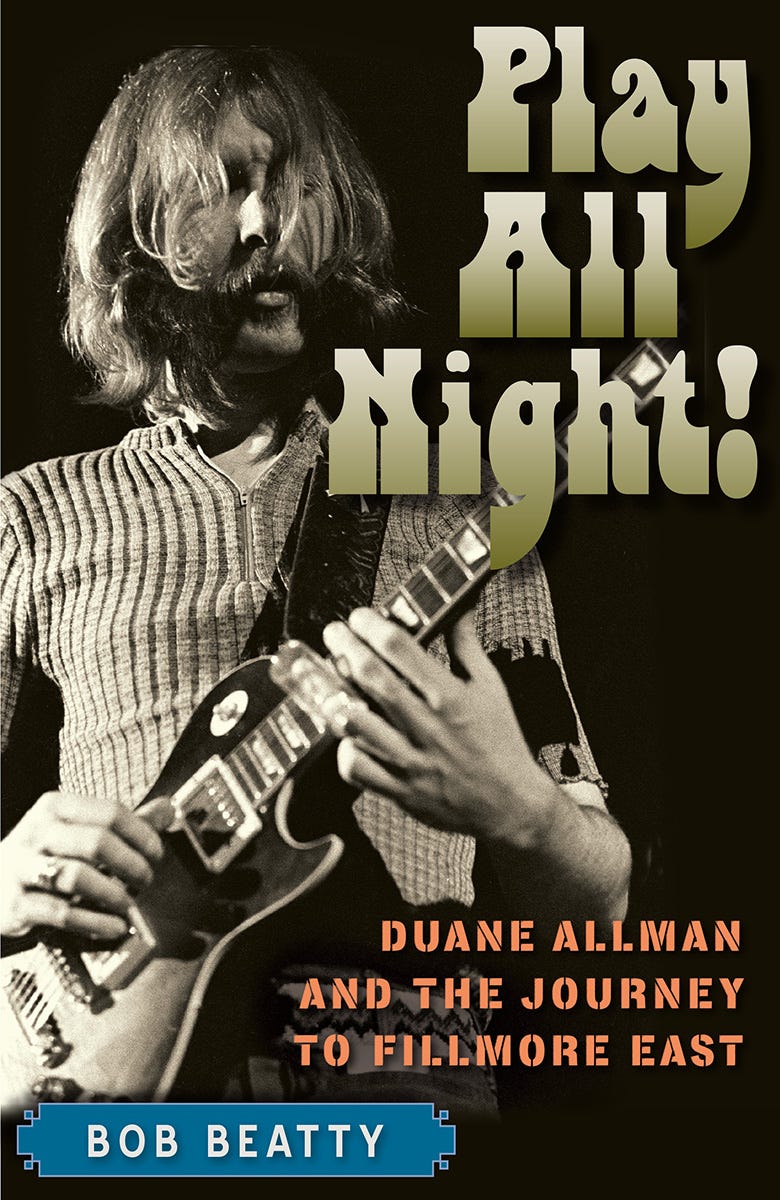
With At Fillmore East, the excitement of the band’s live shows finally translated into record sales.
The success was long in coming and well earned. “It went along so slow for so long, none of us really expected a whole lot to happen,” Trucks reflected. “When we got that gold record, we realized we were doing something.” The band had grown to believe their music was simply too original for the mainstream market. “We knew we were playing music nobody else had played before,” Trucks said, “but none of us had thought about it in commercial terms.” Success brought additional challenges. “Realizing we were commercially successful, that people were starting to listen to us, we had to keep that from influencing our music, keep the music still the six of us having fun,” Trucks said.
“Any comparison is fatuous.
The best damn rock & roll band this country
has produced in the past five years.”
Listeners loved the album. M. Skryp of Quebec wrote to the band,
“Please view this letter of complaint. After spending a small fortune in hard-earned money in amassing a very fine record collection, I recently purchased your new live double LP album. After smoking up some excellent homegrown marijuana (one joint only), I then played your album.
My complaint is this. After listening to your beautiful music, the rest of my records seem irrelevant.
Thank you very much for a wonderful performance. Hope to see you live.
Your dedicated fan, M. Skryp.”1
At Fillmore East, writer Gary Wishik declared, “is the next best thing to actually seeing them,” lacking only “the possibility of an encore that quite possibly could last till dawn.” Rolling Stone’s George Kimball called the album “one of the nicest things that ever happened to any of us. If you’ve been so unfortunate as to never have caught the Allman Brothers Band live, this recording is certainly the next best thing. Turn the volume up all the way and sit through the concert; by the time it’s over you can almost imagine the Allman Band getting high and heading back to Macon.” Wrote Ernie Santosuosso of the Boston Globe, “The Allmans really stretch out but the ‘winging’ is done with a sure purpose.” Marshall Fine of the Minneapolis Star called the album “electric magic, driving and energetic—beautiful.”
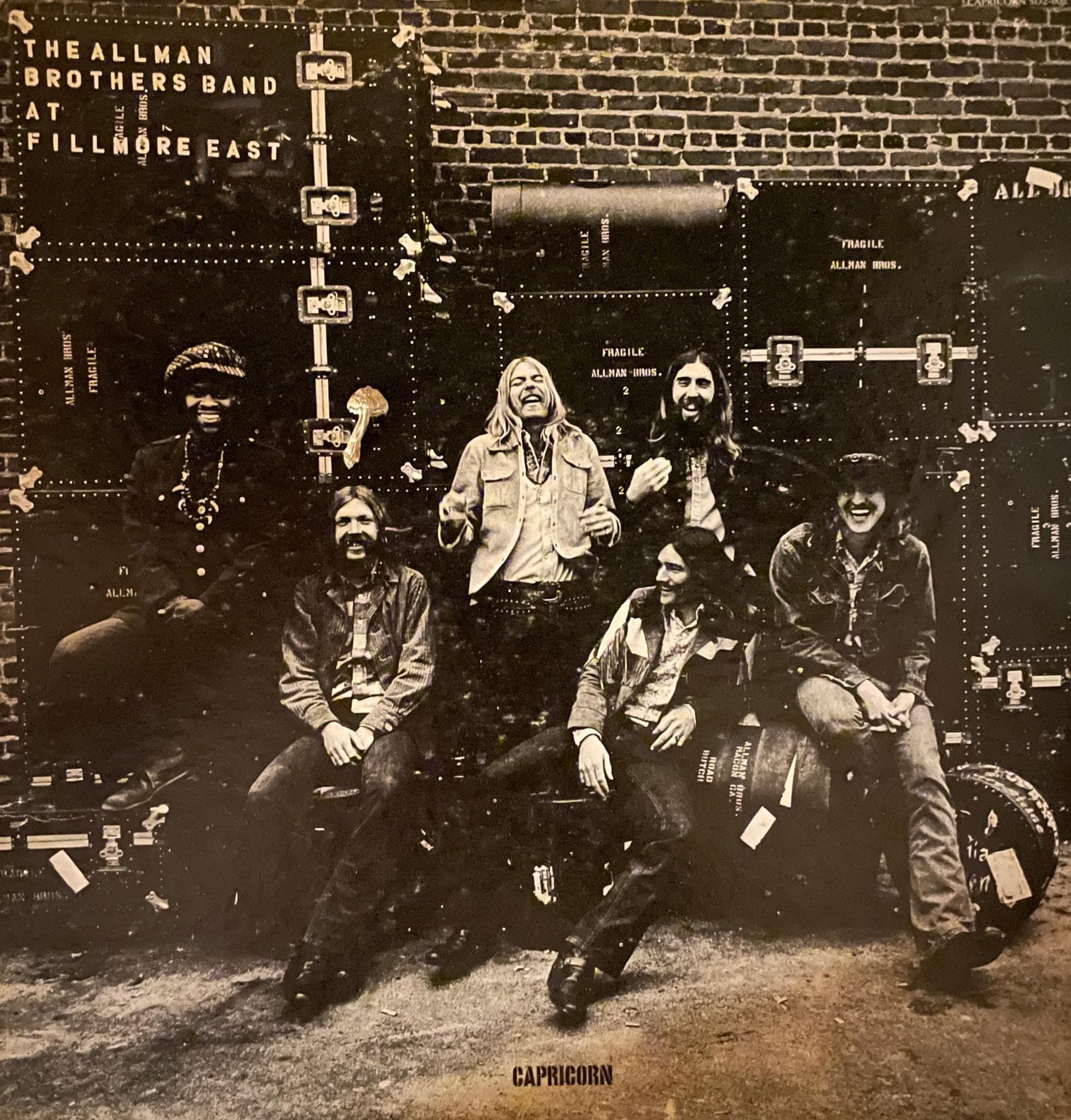
The Grateful Dead remained the standard against which reviewers measured all improvisational rock bands of the era, and At Fillmore East was no exception.2 Rich Aregood found the album “sustained the Dead’s kind of excitement.” Marshall Fine said the record “captures the sound, the energy, and the excitement of a live performance as none have since Live/Dead.”
“Any comparison is fatuous,” Kimball argued in Rolling Stone. “Guitarists Duane Allman and Dickey Betts, organist-vocalist Gregg Allman, Berry Oakley on bass, and drummers J.J. Johanson and Butch Trucks comprise the best damn rock & roll band this country has produced in the past five years.”
“Excellent from beginning to end.
The excitement they generate in live performance manages
to leak through on the recording.”
Critics highlighted the instrumentals “Hot ’Lanta” and “In Memory of Elizabeth Reed.” Reviews loved the contrast between the record’s shorter blues numbers—“Statesboro Blues” and “Done Somebody Wrong”—and the extended blues romps on “You Don’t Love Me” and “Whipping Post.” Santosuosso called “Stormy Monday” “as good as anything else on the album, a sort of tonic in its decelerated, relaxed manner.” Wishik agreed the song showed “the soft and gentle side of the group. Duane is picking the most fragile notes he can find while Dickey Betts is softly sliding in and out, over and behind him and Gregg Allman is lifting the whole thing very gently with a beautiful rhythm pattern from the mighty Hammond B-3 organ.”3
Reviewers found At Fillmore East an authentic representation of the Allman Brothers Band live in concert.
“Musicians’ musicians,” the Clemson University Tiger called the ABB, “one of the best instrumental groups in the country.” Jim Conley assured readers, “You won’t be bored, even though there are only seven cuts on the four sides. From soft mellow blues to cooking rock, they just do it all right.” Aregood called the album “excellent from beginning to end. The excitement they generate in live performance manages to leak through on the recording.”
“We’re a band, man. A band that works like a band.”
Glover found Duane Allman’s musical vision at the heart of At Fillmore East. “In these days of so many groups who are merely competent, and ritualized sets which mostly bore your ass off. It’s a real joy to hear a group that loves to play and can communicate their enthusiasm. Not only have they got their chops together, they know how to use them to create thick, smoking tapestries of blues and rock, tempered with a lyrical aching beauty.” Duane stood out—“sliding out sinuous solos that coo with southern soul”—but he was “only part of the web. Brother Gregg sits high atop his organ, throbbing out long lines of swirling sounds, doing most of the vocal work with a mellow rasp while Dickey Betts plays alternate lead guitar, often in rippling counterpoint to Duane’s loping runs. The rhythm section of double drummers Butch Trucks and Jai Johanny Johanson, bottomed by cooking bassist Berry Oakley are always right there, driving it all along with power and a fine sense of dynamics.”
On Fillmore East, Duane’s music speaks for him and his bandmates. “His complete confidence—like the complete confidence of his band—is right out there,” Scoppa wrote. “No nonsense. He heads straight for whatever he’s after.”
“Where do they want to go from here?” Rolling Stone’s Dubro asked in January 1971. “Mostly they all seemed to want to do what they’re doing. It didn’t seem like they wanted to be stars, just musicians.” Duane had said as much backstage during the Fillmore East sessions in March 1971 when he told Glover, “We’re a band man, a band that works like a band. If we could just get people to come out and see us I know they’d like what they heard.”
The completed album sounds like a band that took immense joy in playing.
Duane quotes Robert Johnson’s “Come on in My Kitchen” (“It’s goin’ to be rainin’ outdoors”) and the Christmas carol “Joy to the World” during “You Don’t Love Me” and playfully teases the seventeenth-century folk song “Frère Jacques” as “Whipping Post” winds down.
“It didn’t seem like they wanted to be stars, just musicians.”
Interludes tell the same story. Duane introduces “Elmore James’s ‘Must’ve Did Somebody Wrong’ [as] an old, true story” playfully adding off mic, “Wonder who?” “Stormy Monday” was “an old Bobby Bland song,” he said, quickly offering a correction. “Actually, it’s a T-Bone Walker song.” Oakley shouts, “Brother Gregg Allman singing the blues! Duane, Dickey, and Ace [Thom Doucette] playing ’em!” as “Stormy Monday” fades out. And as always Duane, gave props to his guitar partner—“a song Dickey Betts wrote from our second album, uh, ‘In Memory of Elizabeth Reed.’”
And in one of the great deadpan introductions in all of live rock, Duane called “Whipping Post” “a little number from our first album,” announcing, “Berry starts ’er off.” In anticipation of the band’s closer, at least five folks yell “Whipping Post” before Oakley plays a note. (The third guy is the loudest.)4
These interludes on At Fillmore East also the Allman Brothers Band as the People’s Band. “Natural, no bullshit people,” Tony Glover said. Live recordings from the era prove the band’s Fillmore East stage announcements weren’t a put-on. Duane and his mates enjoyed themselves on stage, and they let audiences know that.
At Fillmore East also provides a clear example of Butch Trucks’s classical influence on the Allman Brothers Band’s sound.
The influence might at first seem obscure because while the ABB’s music was complex like classical, it was improvised, less structured. Butch’s classical influences inspired the band’s tempo changes and dramatic movements. He translated the “feel” of classical to rock, using the tympani to bring “Hot ’Lanta” and “Whipping Post” to a thunderous conclusion. The latter closed the album, fading as the band segued into “Mountain Jam.”5
After two-plus years of relentless touring, the Allman Brothers Band had finally broken through. The success of At Fillmore East proved Duane’s theory about the importance of a live album for the Allman Brothers. Sadly, he missed out on the success and widespread acclaim the ABB achieved as a result of his artistic masterpiece. On October 29, 1971, just days after learning the album hit Gold, Duane died in a motorcycle crash in Macon. He was just shy of his twenty-fifth birthday. 6
His bandmates responded the only way they knew how: through music. They embarked on a nationwide tour as a quintet, the legendary 5-man band.

Excerpted from
🍄Play All Night! Duane Allman the Journey to Fillmore East🍄
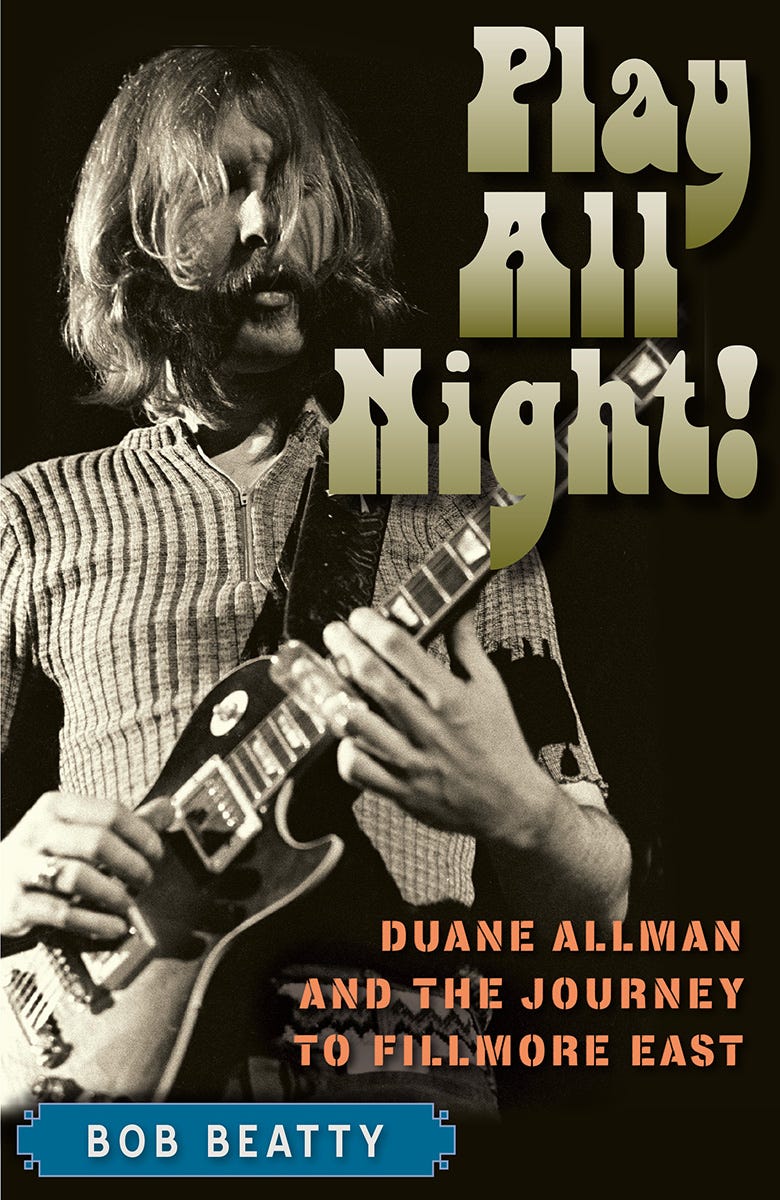
Brought to you by the paid members of the Long Live the ABB community.
🍄MUSHROOM🍄MAGICIANS🍄 Brent W. Hammond, Craig Stevens, Ken Lupson, Laura McCarty, Steve Marshall
🍑 PEACH 🍑 PALS 🍑 Allen Barnes, Art Dobie, Baileys Mike, Bob and Laura, Bob Johnson, Brent Pruner, Bruce Miles, Buddy Lewis, Cabinetsales, Caroline Doolittle, charlie2541, Chuck Zumwalt, Clifford Morse, Cwktwo, Danbookin, Davis Manes, Dennis Newton, Denny, Ed Ashton, Ed Pokorny, F. D., Frank Young, Gary Nagle/Chairman Wonwayout, Gary Smith, Gary Williamson, George Holman, Hlnbkt, Irishbeatz, James Reynolds, James Yerrill, Jcsarphie, JD Guitar, Jeff Kushmerek, Jeff Schein, Jerry K, JoaquinDinero, Joe Sokohl, Joel Berger, Joel Tanzer, John Delaney, John Dolan, John Haughey, Jordan David, Joseph Lilly, Kenton Lee, Kevin Harper, Kevin Walker, Kurt Nielsen, Mark Leitner, Martha Haynes, Mike Clark, Peter Poulos, Phillip Page, Preston Root, Randy Woodall, Ray Tillman, Robert Porter, Rose Brandt, Scott Green, sswoger, Stanleyglennie8, Surrender Cobra, Taylor Kropp, Tim Langan (Hot ‘Lanta Tim), Tina Christopher, Tom Pragliola, Tony Gioia, Wade McCurdy, Wiszowa

One of my ABBsolute favorite quotes in Play All Night! I found this letter in the archives of the Big House Museum in Macon. Skryp sent it to Atlantic Records in November 1971. Duane had already died.

Also a significant influence on the Allman Brothers Band, particularly Berry Oakley.

It’s somewhat mind-boggling to consider how good this version of “Stormy Monday” is. It’s more than just a first take, the first time they played the song in four* shows over two days was during the fourth show. (*We don’t know what they played Thursday, March 11; tapes have never surfaced.)
Listen even more closely and you’ll hear at least two people call out for “Dreams.”

The band’s resilience in the face of Duane’s death is remarkable.

🍄🍑MERCH🍑🍄
Created this to honor the Allman Brothers Band’s March 1971 run at Fillmore East. You’ll see the original ad below, which had Johnny Winter at the top of the bill.


I read your book sometime ago but kept it on my self but it's nice to read what you have posted again. I used to try and see them every time that they came through Seattle but the show in the old Seattle Arena on October 29th, 1994 is still one of the best concerts I have ever attended. They were smokin' hot and their energy level was the best I had ever seen and heard them. There is a bootleg copy around that captures it pretty well. A young 15 or 16 year old Duane Betts would come out for a solo duing the latter half of Elizabeth Reed. Allan Woody was so energized and on fire that he had to eventually slow down his tempo. I still think he is one of the most underrated members in their history. But this night belonged to Warren and Dickey.
In the 80's when the band was on a break, I would see Dickey with his band Great Southern, close a show with Roy Buchanon and Lonnie Mack at a large club called Parker's Ballroom and he literally burned the place down. There have been a lot of great guitar players but no one could SWING and sing melodic lines like Dickey Betts. No one. I used to have a tape of that show but it has been lost to who knows where.