

"The Allman Brothers did it all. On stage they were giants." At Fillmore East at 55
Excerpt from Play All Night! Duane Allman & the Journey to Fillmore East (part 1 of 4)

The Allman Brothers Band released At Fillmore East on July 6, 1971. For the album’s 55th anniversary, I am publishing excerpts from Play All Night! Duane Allman & the Journey to Fillmore East.
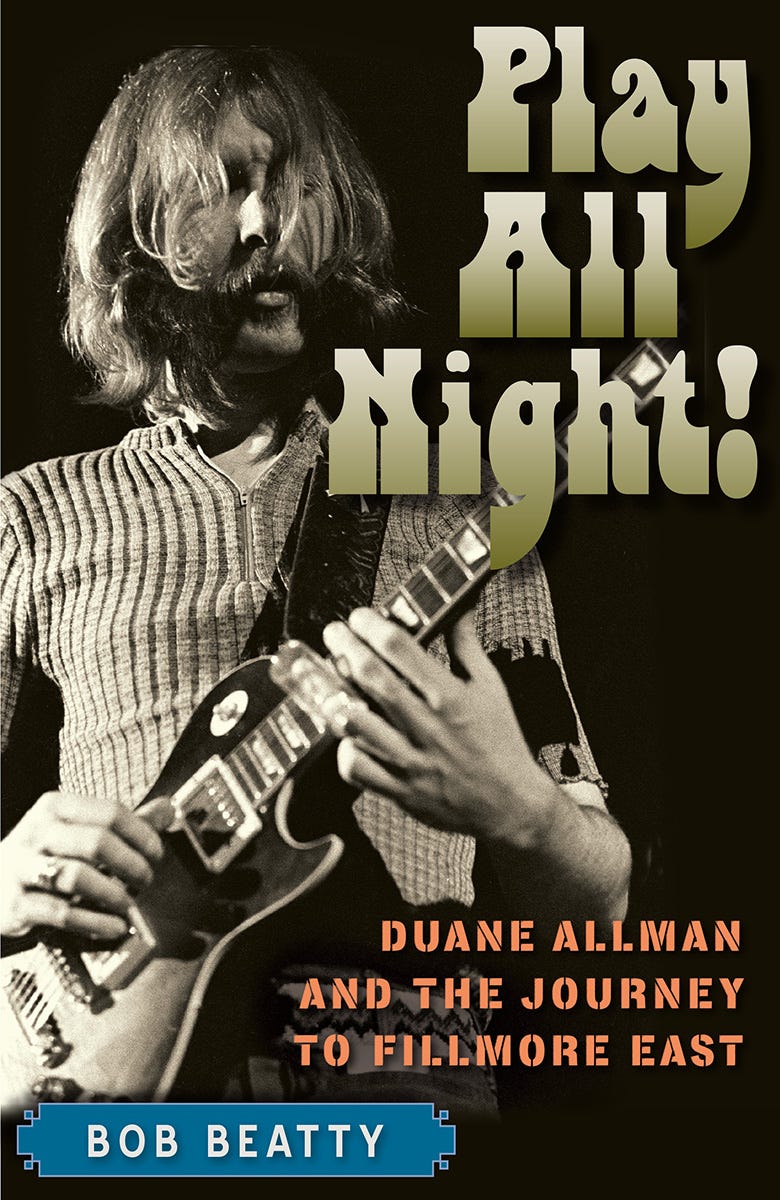
The book is the biography of a sound, the Allman Brothers Band at their artistic height. Everything was on the line for Duane and the Allman Brothers Band with At Fillmore East. Everything. The decision to release a live album was not as obvious as it might seem in at first glance.
This is part one of four, Recording At Fillmore East (March 11-13, 1971)
Phil Walden agreed that a live album was the best way to build on the audience Duane and the band had worked so hard to develop.
The decision was not without risk. While live albums were common, they were typically a way established artists generated sales between studio albums. The Allman Brothers Band had no such credibility and instead used a live album to grow its commercial presence. At Fillmore East is the quintessential Allman Brothers Band recording and pinnacle of Duane Allman’s meteoric career.
Fillmore East also presented a decidedly American take on contemporary music, critic Bud Scoppa wrote. The ABB were “a reminder that rock & roll didn’t start out to be a mean but ambiguous kind of music played by fey and mannered young Britishers” like the British blues artists who had actually introduced electric blues to much of white America. “The real rock & roll was hard, blues-rich, powerful, and overtly virile stuff.”1
Atlantic promo men Philip Rauls and John Carter likewise lauded the band’s stage prowess. “The Allman Brothers did it all,” Rauls said. “On stage they were giants.” As Carter recalled, “Every night was different. I’ve never seen a band that was so spontaneous and reacted so well to each other. It was absolutely real and spontaneous and driven by greatness.” Tony Glover wrote that the Allman Brothers have “their chops together—and know how to use them to create thick smoking tapestries of blues and rock, tempered with a lyrical aching beauty.”
He found it genuine. “No one is into aerobatics or sex shows, they just stand there and play their heads off.” They played “powerhouse rock & roll” that combined the electric blues of Muddy Waters and Miles Davis’s Bitches Brew–era jazz fusion. “The tightest instrumental group I’d ever heard.” Audiences loved it. “The force of the whole band playing with that incredible single-mindedness gets people on their feet after practically every number,” Scoppa observed. Their music “may get very free and loose and sophisticated at certain points, but it’s always got its chest out and its eyes open. Part of the masculine feel comes from the patterned thunder of Jai Johanny’s and Butch Trucks’s double drumming, part from the two guitars circling each other like a pair of killer falcons.”
Rolling Stone’s Alex Dubro found the approach “incredibly versatile and highly musical.” While jazz left contemporaries in “hopeless befuddlement,” Dubro argued, the ABB “grab the latitude allowed by jazz changes and add power.”
Eric Clapton left an August 1970 Allman Brothers concert in Miami enthralled.2 “The music was unbelievable, because they were doing all that harmony playing. Everything seemed to be, even if they played solos, they were all in harmony. It was fantastically worked out. The impression that I got was how much hard work they’d put into their presentation, and the fact that it wasn’t really blasted all over the airwaves, you know? They had just quietly gone about doing a fantastic job of making really, really good music that was really well thought out.”
Thus, Duane returned to Clapton some of the inspiration he took from him.
“They influenced my music at the time,” Clapton said. “They made it okay for a band to be live all the time—their thing was really more about live than [studio].” Clapton cited the Allman Brothers’ expansiveness in expressing his frustration with Cream. “We were really limited onstage,” he said. “We could go into the studio and make great records by overdubbing—I would play a rhythm part, and then a lead part with a harmony to it, so you’re really talking about three guitar [parts].” The Allman Brothers Band had no such limitations.
Though it was rare for underground artists like the Allman Brothers to release a live record, concert albums otherwise were common. Some artists used live albums to introduce new material or change musical direction. John Coltrane’s Coltrane “Live” at the Village Vanguard (1962) is an example of both. Johnny Cash’s At Folsom Prison (1968) and At San Quentin (1969) established Cash as the Man in Black, champion of the underdog. Many live records were attempts at a midstream career boost, such as James Brown’s self-funded Live at the Apollo (1963), which spent more than a year on the Billboard pop albums chart. But most live albums—B. B. King’s Live at the Regal. At Newport by Muddy Waters, failed to chart altogether.
It took until the mid-1960s for label executives to realize that there was a market for live rock & roll albums. The breakthrough was the Beach Boys’ Beach Boys Concert. Released in 1964, it spent sixty-two weeks on the charts, four of them at number 1. Two years later, the Rolling Stones released Got Live If You Want It!, which reached number 6.
Most live albums (including the Beach Boys and Stones) were heavily overdubbed in post-production. It was common, said Dickey. “There was kind of a running joke in the music business. Nobody said it in public in an interview or anything, but people would say, ‘The only thing live on such-and-such record was the audience.’ A lot of times they would go back into the studio and redo things; redo vocals and stuff.”
Soon, band and labels began including live tracks on studio albums. After Clapton left the Yardbirds, their label slapped four of his live cuts on 1965’s Having a Rave Up with the Yardbirds. By the end of the decade, half of the tracks on Cream’s final two albums, Wheels of Fire and Goodbye Cream, were live. Among them their most famous track, “Crossroads.”
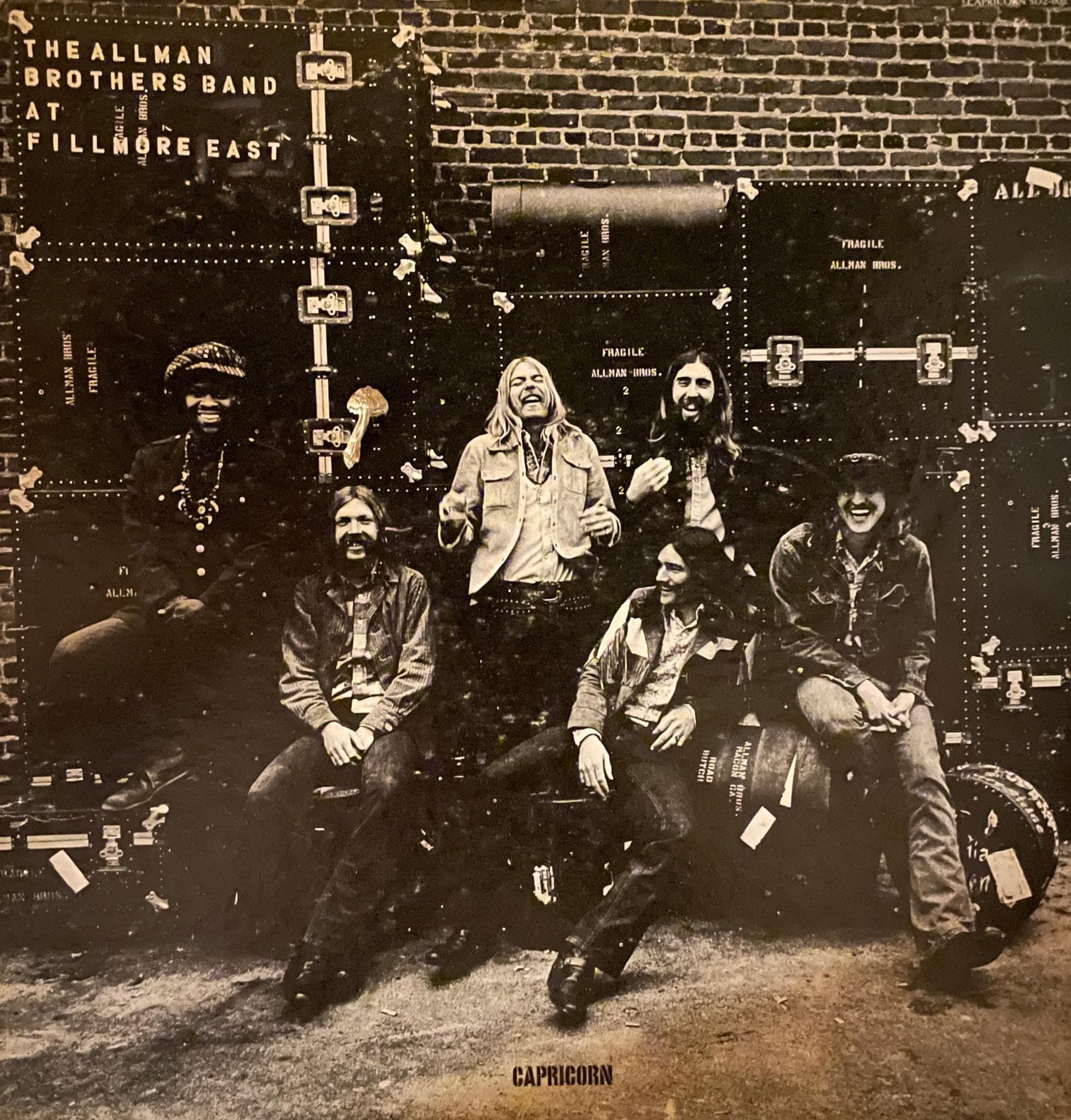
The Allman Brothers Band used the live album in an altogether different way. A live album in place of another studio record. It was a low-cost gamble that they didn’t require expensive studio time.
Labels had supported the live releases as low-cost investments that kept audiences buying records. The Allman Brothers had no such cachet. The group was an underground phenomenon with a lot of buzz but somewhat minimal presence in the marketplace.
A comparison to the Grateful Dead is useful. Although the Dead was America’s premier improvisational and experimental live rock act since its earliest days, they, too, struggled with studio recordings. The Dead’s second album, Anthem of the Sun, in 1968, included live and studio cuts. Sales flagged, as they did for its follow-up, Aoxomoxoa, released the following year. In debt to Warner Brothers for $250,000, the Dead doubled down. Rather than recording a studio album and touring behind the album, the Dead recorded their next album live. Live/Dead proved to be a breakthrough and one of the most revered live records of the era.
Whether the Allman Brothers Band considered Live/Dead when they decided to record their third album live is immaterial. The connection matters most because these two similarly influenced, influential, innovative, improvisational bands understood their best showcase was a live album. The excitement of the live experience was how the groups best expressed themselves musically, and the resulting albums confirmed that instinct.
Live/Dead didn’t sell all that well, only reaching number 64 in fifteen weeks on the charts. But it sounded as close to the experience of a live Grateful Dead concert as possible, and it brought in new fans along the way. With At Fillmore East, the ABB would find the same results.
At Fillmore East also became part of a campaign to take advantage of the Allman Brothers’ reputation as the “People’s Band.”
The band’s relentless touring schedule garnered a significant following. As Jonny Podell, the band’s New York–based booking agent, recalled, “The word had got out. The tastemakers—Bill Graham and Rolling Stone—had come out forcefully in favor of the Allman Brothers. The network of underground clubs, from Boston Tea Party to the Fillmore West, clearly supported the Allman Brothers, and would play them five times a year if they could.”
Translating the live sound to vinyl was the right next step. The Allman Brothers would record the album at Bill Graham’s Fillmore East.3 The venue at 105 Second Avenue in New York City’s East Village, was nearly as important as the music itself. Graham’s productions dissolved the line between musician and audience. “Performers interacted with the audience to form a unit,” Fillmore West manager Paul Baratta said, “not just somebody performing at an audience.” The dynamic was tailor-made for the Allman Brothers Band, whose concerts were as much a chance for the band to perform for the audience as it was for the band and audience to celebrate life together.
Betts called Fillmore East “the Carnegie Hall of rock & roll. Graham made a great presentation of rock & roll with light shows and curtains and presentations of the bands and the set changes.” Most importantly, he said, the room sounded fantastic. “The P.A. system was set up correctly. It wasn’t too loud, it wasn’t too soft, and everyone in the room could hear and see.” Jaimoe said, “That stage was smoking.”
Excerpted from
🍄Play All Night! Duane Allman the Journey to Fillmore East🍄
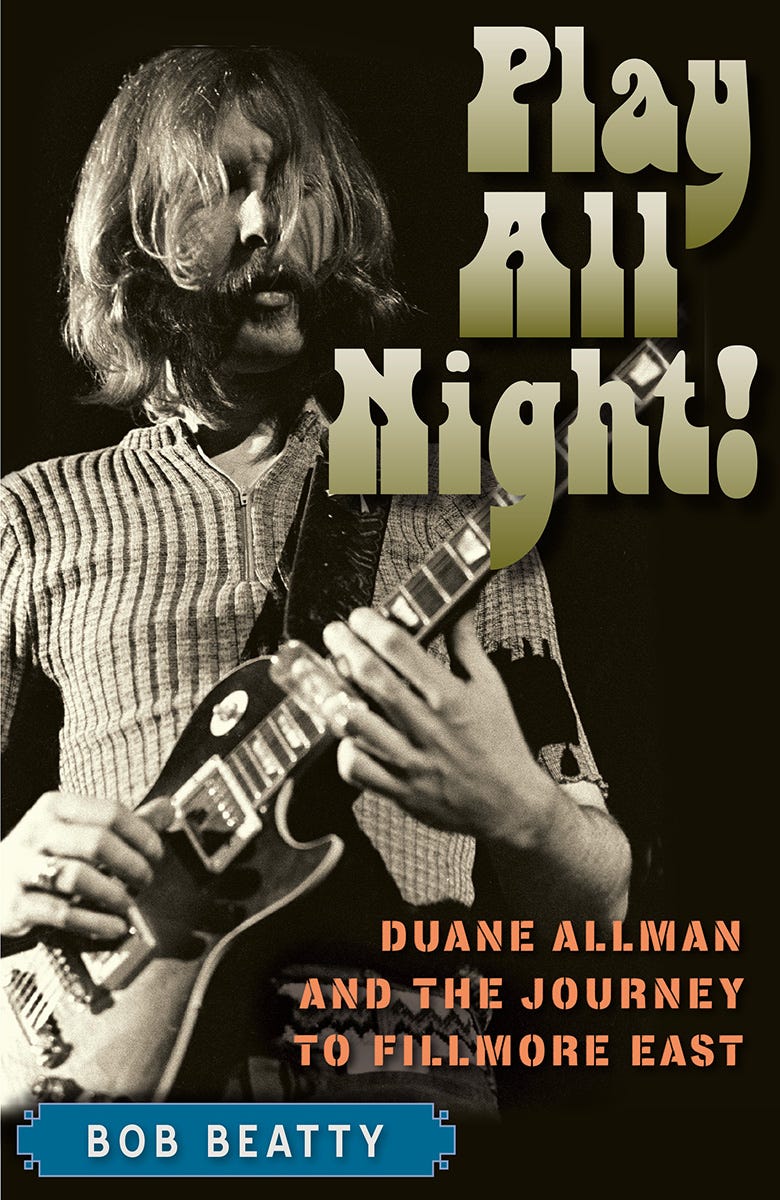
STAY TUNED FOR PARTS 2 THROUGH 4

Brought to you by the paid members of the Long Live the ABB community.
🍄MUSHROOM🍄MAGICIANS🍄 Steve Marshall, Brent W. Hammond, Ken Lupson, Laura McCarty
🍑 PEACH 🍑 PALS 🍑 Allen Barnes, Art Dobie, Baileys Mike, Bob and Laura, Bob Johnson, Brent Pruner, Bruce Miles, Buddy Lewis, Cabinetsales, Caroline Doolittle, charlie2541, Chuck Zumwalt, Clifford Morse, Craig Stephens, Cwktwo, Danbookin, Dennis Newton, Denny, Ed Ashton, Ed Pokorny, F. D., Frank Young, Gary Nagle/Chairman Wonwayout, Gary Smith, Gary Williamson, George Holman, Hlnbkt, Irishbeatz, James Reynolds, James Yerrill, Jcsarphie, JD Guitar, Jeff Kushmerek, Jeff Schein, Jerry K, JoaquinDinero, Joe Sokohl, Joel Berger, Joel Tanzer, John Delaney, John Dolan, John Haughey, Jordan David, Joseph Lilly, Kenton Lee, Kevin Harper, Kevin Walker, Kurt Nielsen, Mark Leitner, Martha Haynes, Mike Clark, Peter Poulos, Phillip Page, Preston Root, Randy Woodall, Ray Tillman, Robert Porter, Rose Brandt, Scott Green, sswoger, Stanleyglennie8, Surrender Cobra, Taylor Kropp, Tim Langan (Hot ‘Lanta Tim), Tina Christopher, Tom Pragliola, Tony Gioia, Wade McCurdy, Wiszowa

This commentary reflects some of the conversation Susan Ferentinos and I had on a recent Conversation from the Crossroads

A meeting that resulted in Duane joining the Layla sessions.


Quite proud of this co-production with my daughter Ryan.

Love your book Bob. Even though I have read it all the way through twice, I still love the excerpts you publish on this site. Long live the ABB. The road goes on forever.