

The Allman Brothers Band released At Fillmore East on July 6, 1971. On the album’s 55th anniversary, I am serializing excerpts from Play All Night! Duane Allman & the Journey to Fillmore East: the biography of a sound, the Allman Brothers Band at their artistic peak.
Everything was on the line for Duane and the Allman Brothers Band with At Fillmore East. Everything. The decision to release a live album was not as obvious as it might seem on the surface. Neither was the choice to make it a double album. Or sell it for a single album price.
This is part three of four, At Fillmore East Breaks Through (Summer and Fall 1971)
Part 1
Part 2

As 1971 dawned, the Allman Brothers Band found themselves at a crossroads.
The group had toured relentlessly for nearly two years. They had released two studio albums that had gained critical acclaim but scant commercial success. Duane remained undaunted. “I guess success depends on how many people dig you/ You play what you feel and hope you’re doing the right thing. You’ve got to do whatever you believe in. If you’re wrong, you change and keep making changes till you make it—or till you’re happy with the whole thing.”
The band’s manager/record label owner1 Phil Walden agreed with Duane’s idea that a live album was best. The decision was not without risk. While live albums were common, they were a way established artists generated sales between studio albums. The Allman Brothers Band had no such credibility and would instead use the medium to grow its audience. A live record would present their music at its absolute best.
At Fillmore East became the quintessential Allman Brothers Band recording, the pinnacle of Duane Allman’s meteoric career.2
Fillmore East also presented a decidedly American take on contemporary music. It was, critic Bud Scoppa contended, “a reminder that rock & roll didn’t start out to be a mean but ambiguous kind of music played by fey and mannered young Britishers” like the British blues artists who had actually introduced electric blues to much of white America. “The real rock & roll was hard, blues-rich, powerful, and overtly virile stuff.”3
It is unclear exactly when the ABB decided to issue a double album of new and older songs. A single album would have made sense, but Phil Walden argued that the band’s performances warranted more. He fought with his partner in Capricorn Records, Atlantic Records’ Jerry Wexler, to release a double album. “I told Wexler that our Fillmore East live album would have to be two LPs and contain at least one sixteen-minute song,” Walden said. “Not every note is vital to our heritage,” Wexler replied. “The boys are pure artists and that’s what it’s got to be,” Walden argued.
Ultimately, the caliber of the March 1971 Fillmore East performances and recordings made the decision an easy one. “Jerry agreed, he understood.” Wexler said, “What I understood was that I had never heard a guitarist I found as satisfying as Duane.”
Walden then presented an additional demand. “Our image is that this is the People’s Band. Music is for the people and therefore we want to make this specially priced”—a double album for the cost of a single record. Wexler was apoplectic, and relented only after Walden agreed to cut a deal on song publishing for the three original Allman Brothers Band songs on the record—“In Memory of Elizabeth Reed,” “Hot ’Lanta,” and “Whipping Post.” (A decision that cost the band millions over the years.)4
Walden’s gamble paid off, and At Fillmore East became the breakthrough that the band, its manager, and Atlantic Records had long sought.
“I don’t think anyone could’ve predicted the extent of the album’s success but we were counting heavily on it,” Walden said. Trucks recounted, “Two years of playing every city in the country, we built a following. When that live album came out that’s what everybody was waiting for.”
The album was as near a representation of the band’s live performances as possible. Unlike many live albums of the period, including the Grateful Dead’s eponymous live album, At Fillmore East had “no overdubs whatsoever,” Betts said. “No vocal overdubs, no repair work.” Other than a splice of two versions of “You Don’t Love Me” and removing a harmonica solo in “Stormy Monday,” he said, “there was nothing done to that. It’s just a pure performance.”
Explained Walden, “At Fillmore East is absolutely live. We didn’t go back and re-record one guitar solo; we didn’t add anything to it. The live album gave them an opportunity to play on record as they played in person. That was really the turning point.”
“The band had not really found themselves in the studio,” Walden said, “but they had in front of live audiences where they had more freedom; they opened up. They weren’t a three-minute-cut band.” At Fillmore East gave the ABB the opportunity to stretch out.
“No record [is] as good as hearing the band live,” Tony Glover wrote, but Fillmore East “comes close to capturing the feelings they generate.”
The album features nearly eighty minutes of music spread across just seven tracks. Five of the seven songs were new, and only two, “Statesboro Blues” (4:17) and “Done Somebody Wrong” (4:33), were even remotely of the appropriate length to be released as singles, although neither was.
Two cuts, “In Memory of Elizabeth Reed” and “Hot ’Lanta,” are instrumentals, jazz/rock hybrids, but not the fusion of Miles Davis, Tony Williams Lifetime, and Mahavishnu Orchestra. Song lengths mirrored Coltrane’s Village Vanguard albums. Five songs top five minutes, three exceed twelve, and two, “You Don’t Love Me” and “Whipping Post,” are twenty minutes each.
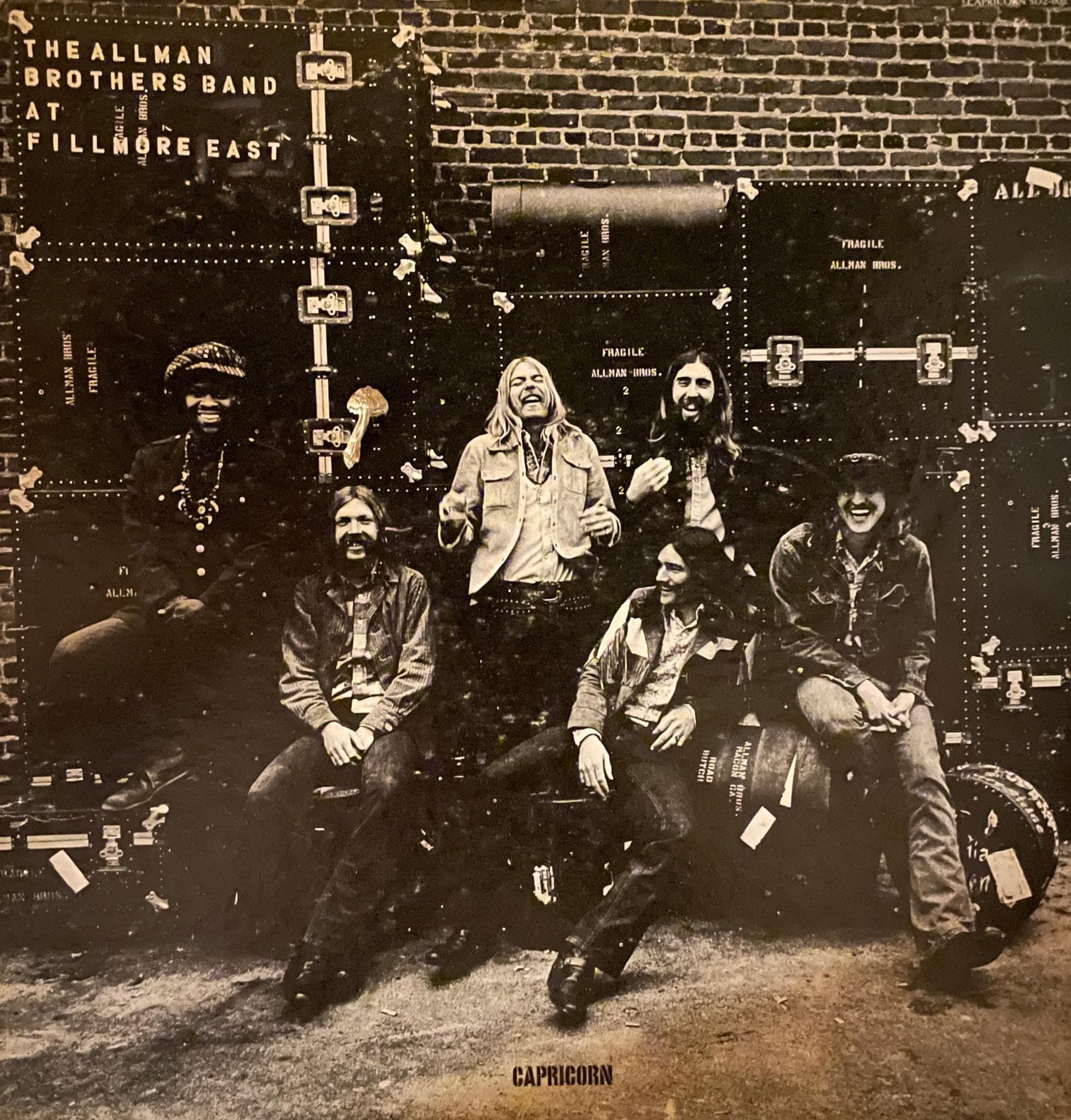
At Fillmore East was music for serious music listeners; it found an audience on the FM radio format.
In the pre-streaming world, most people accessed music through radio. For much of the twentieth century, AM dominated the market; its more powerful, lower-fidelity signal reached a wider geographic audience than later FM’s less powerful, higher-quality signal. Because advertisers paid to reach listeners and pop music kept listeners listening, that’s what AM stations programmed.
A 1965 Federal Communications Commission ruling prohibiting AM stations from retransmitting programming on FM sister stations changed everything. The decision forced hundreds of stations to develop new formats nearly overnight. Many turned to freeform, a format devoid of the influence of the singles chart. FM played tracks that AM programmers ignored altogether. Freeform playlists featured a wider spectrum of music and favored longer album tracks over singles.
Underground FM radio of the late 1960s and early 1970s was, scholar Michael C. Keith writes, “in step with that of the growing counterculture. It resented the mainstream gestalt of the day regarding social issues (war, drugs, race), but most of all it detested formula radio.” FM DJs and their listeners found At Fillmore East far from formulaic. As stations began focusing on album cuts, FM became where true music aficionados tuned in.
FM was the perfect medium for the music of the Allman Brothers Band. FM’s predilection for album cuts was critical to the breakthrough success of At Fillmore East. “The Allman Brothers were an FM radio band,” Atlantic’s Philip Rauls said. John Carter, also from Atlantic, said, “People couldn’t believe the number of records the Allman Brothers were selling on what appeared—to the old school—as no airplay. The small audience that was listening to those FM stations was religious about it.” The band knew this. Its instrumentals and “drawn-out pieces were not really commercial,” Betts reflected. “If it hadn’t been for FM radio that would play these extended pieces of music, we would never have been successful.”
Upon release July 6, 1971, At Fillmore East stormed the charts. The album jumped to number 82 within three weeks of release. By September 4, it reached its highest chart position, number 13, and by October 25, the album had reached gold, at more than 500,000 copies sold. It spent forty-eight weeks on the Billboard 200, a mammoth achievement for a band who’d barely sold 100,000 combined units to date.
Excerpted from
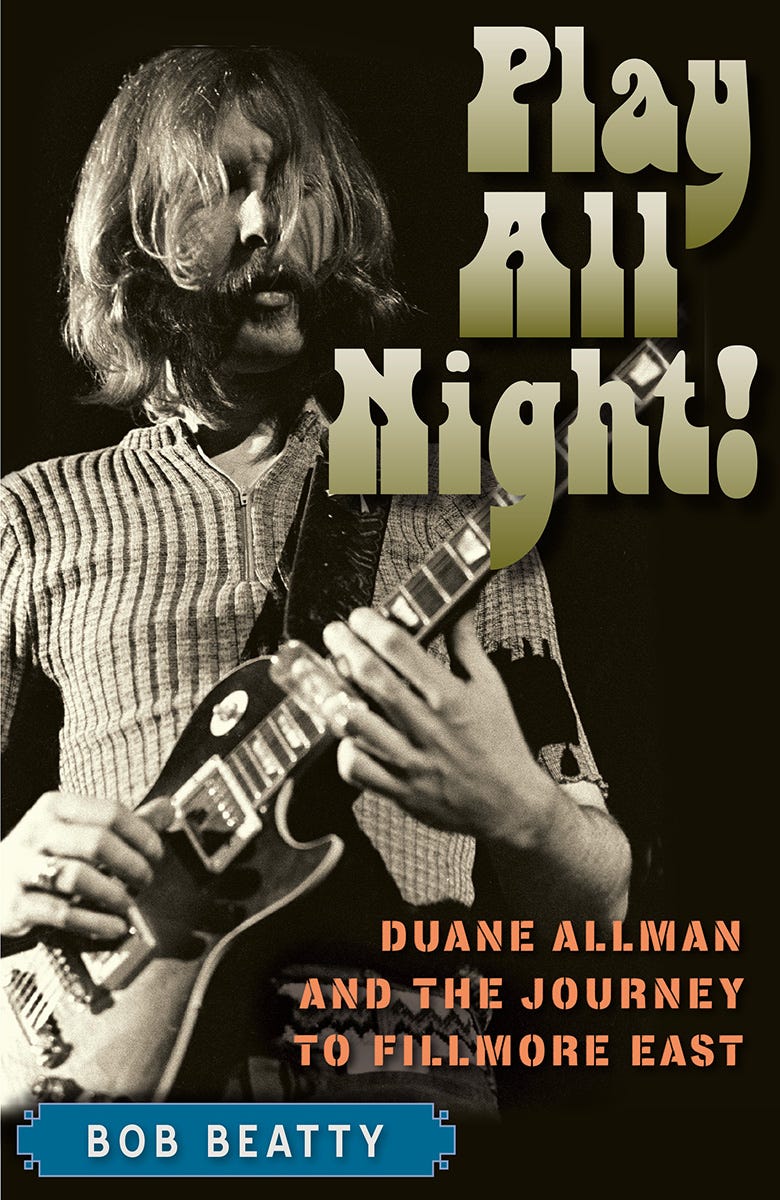
🍄Play All Night! Duane Allman the Journey to Fillmore East🍄
Brought to you by the paid members of the Long Live the ABB community.
🍄MUSHROOM🍄MAGICIANS🍄 Brent W. Hammond, Craig Stevens, Ken Lupson, Laura McCarty, Steve Marshall,
🍑 PEACH 🍑 PALS 🍑 Allen Barnes, Art Dobie, Baileys Mike, Bob and Laura, Bob Johnson, Brent Pruner, Bruce Miles, Buddy Lewis, Cabinetsales, Caroline Doolittle, charlie2541, Chuck Zumwalt, Clifford Morse, Cwktwo, Danbookin, David Manes, Dennis Newton, Denny, Ed Ashton, Ed Pokorny, F. D., Frank Young, Gary Nagle/Chairman Wonwayout, Gary Smith, Gary Williamson, George Holman, Hlnbkt, Irishbeatz, James Reynolds, James Yerrill, Jcsarphie, JD Guitar, Jeff Kushmerek, Jeff Schein, Jerry K, JoaquinDinero, Joe Sokohl, Joel Berger, Joel Tanzer, John Delaney, John Dolan, John Haughey, Jordan David, Joseph Lilly, Kenton Lee, Kevin Harper, Kevin Walker, Kurt Nielsen, Mark Leitner, Martha Haynes, Mike Clark, Peter Poulos, Phillip Page, Preston Root, Randy Woodall, Ray Tillman, Robert Porter, Rose Brandt, Scott Green, sswoger, Stanleyglennie8, Surrender Cobra, Taylor Kropp, Tim Langan (Hot ‘Lanta Tim), Tina Christopher, Tom Pragliola, Tony Gioia, Wade McCurdy, Wiszowa

And publisher and booking agent. By the end of the 70s, Walden’s inner dealings caught up to him and the band, bankrupting the entire Capricorn empire.
Excerpt from Chapter 1 of Play All Night!, “Duane’s musical ethos.” (What you’re reading here is from Chapter 13.) https://www.longlivetheabb.com/p/skydog
This brings to mind the discussion on gender that Susan Ferentinos and I had in a recent Conversation from the Crossroads. www.longlivetheabb.com/p/crossroads-ferentinos
Backstory from the excellent 1976 Allman Brothers’ bio by Tom Nolan, which I’m serializing. www.longlivetheabb.com/p/nolan-fillmore
🍄🍑MERCH🍑🍄
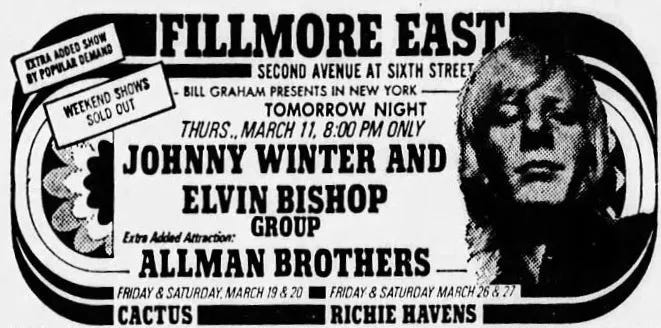
Created this to honor the Allman Brothers Band’s March 1971 run at Fillmore East. You’ll see the original ad below, which had Johnny Winter at the top of the bill.


Here’s the original ad. I moved the Allman Brothers to the top of the bill, and replaced Winter’s photo with Long Live the ABB shroom #2 by Psychodelik Pete/Peter Nogas.
Great stuff on this 55th anniversary. Still can't be touched,most amazing interplay of guitarists ever,trading licks. Every band member hitting the note.☮️🍄🟫🎶🍄✌️