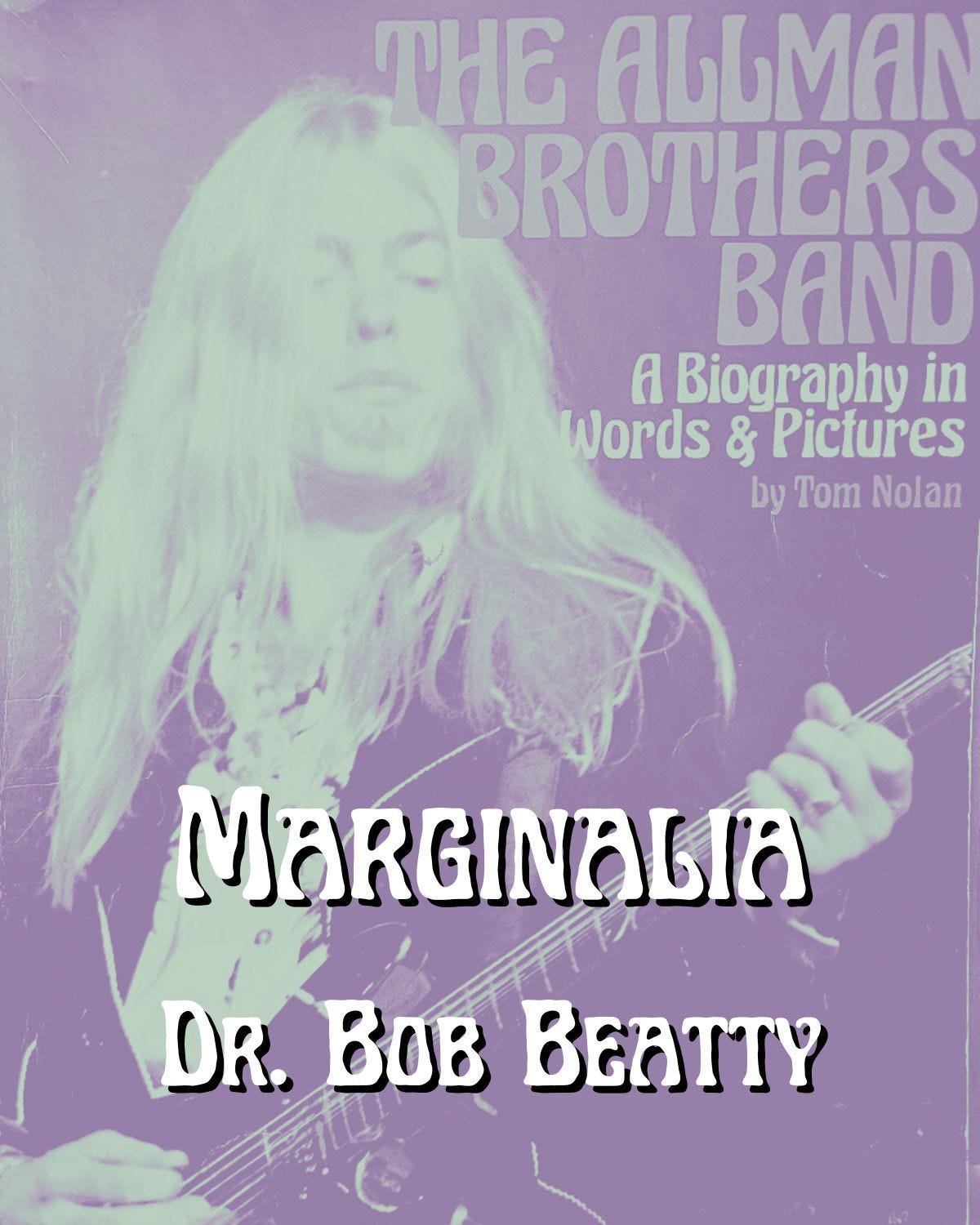
Here’s a post from my marginalia series, an annotated read of Tom Nolan’s The Allman Brothers Band: A Biography in Words & Pictures(1976). This post gives context to the machinations between the record company people. Jerry Wexler wanted one disc. Phil Walden and the Allman Brothers held the line. The record was four sides, seven songs, no overdubs, and only two edits.
The Allman Brothers were the People’s Band, Walden said, and they’d sell the double album for a single album price. The record turned a road band with two underperforming studio records into one of the defining acts in rock.
Allman’s work on Layla so revitalized the Dominos that they asked him to join them as a permanent member; when he demurred, saying “He had his own biscuit to fry” with the ABB. Someone suggested putting both groups together. “Wouldn’t that have been a band!” exclaims Bobby Whitlock.
Although Duane did appear onstage with the Dominos for at least two concerts, he never seriously considered these offers.
He was too committed to the group he had put so much effort into—a group which was, after three years of relative obscurity, about to turn the corner into the bigtime.
Duane definitely gave the offer serious consideration. I mean, who in their right mind would turn down Eric Clapton?!
“I really don’t know what to do,” he wrote his wife Donna. “It would mean about $5,000 a week to us, as well as a home in England and a lot of things we’d like to have. . . . I’m really up in the air right now.”
Jaimoe knew “Duane had more going playing with us than with Eric.”
Duane agreed.The following spring, March 12-13, 1971, he and his band recorded their landmark album: At Fillmore East (pages from the book are basically the second column on p32 and the first column on p34 available here).
The beginning of the great popular acceptance which would be enjoyed by the Allman Brothers Band came with the release of their two-record live album: At Fillmore East.
Phil Walden recalls there was opposition from key Atlantic Records personnel to putting that album out in its final form.
“The tunes are too long,” they said. “These jams aren’t that important.”
Pricing it at $6.98 was thought to be too expensive.
“You can’t have a double album with a band that hasn’t broken big yet. To have a live album before you’ve had a really successful studio album doesn’t make sense.”
Everything, according to certain people, was all wrong; but it turned out to be all right.
The band had not really found themselves in the studio at that time; but they had, in front of live audiences. They had more freedom there; they opened up. They weren’t a three-minute-cut band.
The live album gave them an opportunity to play on record as they played in person; and people reacted to that. That was really the turning point.
Here’s Phil Walden telling this same story from a CMT documentary released in the 00s. The whole thing is fantastic, but this snippet is gold.2I’ve got it queued up to the point Walden recounts his conversation with Wexler, his Capricorn Records partner and Atlantic Records’ executive.
Remember, too, that Capricorn was also an Atlantic subsidiary, giving Wexler twice the right to tell Walden a double album sold for a single album price was not gonna fly economically.
These are obvious conflicts of interest, particularly as the band grew more successful. Wexler was an Atlantic executive and co-owner of Capricorn. Walden was the ABB’s manager, co-owned its record label, and controlled its publishing. Wexler might make decisions that were best for Atlantic but not for Capricorn; Walden could choose something that was best for Capricorn but not the ABB.3
Ultimately, the caliber of the March 1971 Fillmore East performances and recordings made the decision an easy one. A single album would have made sense, but Walden argued that the band’s performances warranted more, and he fought to release a double album.
“I told Wexler that our Fillmore East live album would have to be two LPs and contain at least one sixteen-minute song,” Walden said.
“Not every note is vital to our heritage,” Wexler replied.
“The boys are pure artists and that’s what it’s got to be,” Walden argued, adding, “Jerry agreed, he understood.”
What Wexler understood was that he “had never heard a guitarist I found as satisfying as Duane.”
Walden presented Wexler with an additional demand: “Our image is that this is the People’s Band. Music is for the people and therefore we want to make this specially priced”—a double album for the cost of a single.
Wexler relented only after Walden agreed to cut a deal on song publishing for the three original Allman Brothers Band songs on the record—“In Memory of Elizabeth Reed” “Hot ‘Lanta” and “Whipping Post”—a decision that probably cost the band millions in royalties.
On this album, recorded March 12 and 13, 1971 at Bill Graham’s New York venue, we hear at last a great band in full possession of its considerable intelligence and stamina: in sound mind and body, as it were.
Whether because of the rapport generated by a live setting, or simply because some necessary time had elapsed, the Allman Brothers at last achieved their appropriate mixture of taste and power.
With grace they move repeatedly from subdued, engrossing, intricate levels, to brilliant and fiery cascades of notes, and back again to quieter yet equally exciting areas.
Guitar solos of the perfect logic blend seamlessly into arranged sections; the music rushes forward, pauses, maneuvers around a bend and continues onward with the force of a natural stream—liquid, pure, flowing, offering constant diversion to the attentive senses.
First, pause a moment to revel in Nolan’s prose. This is some of the best writing on the Allman Brothers Band I’ve ever encountered.
A band in full possession of its considerable intelligence and stamina
finding a mixture of taste and power
and playing with grace as they move from subdued, engrossing, intricate levels, to brilliant and fiery cascades of notes, and back.
The music rushes forward, pauses, maneuvers…liquid, pure, flowing.
The album was as near a representation of the band’s live performances as possible. A pure artistic statement.
At Fillmore East gave the ABB the opportunity to stretch out. “No record is as good as hearing the band live,” Tony Glover wrote, but At Fillmore East “comes close.”
Said Walden, “We didn’t go back and re-record one guitar solo; we didn’t add anything to it. The live album gave them an opportunity to play on record as they played in person. That was really the turning point.”
“Elizabeth Reed” has expanded from the interesting album track of Idlewild South4to the 12-minute-plus concert piece its dramatic conception warrants.
It is a highlight of the record and among the best pieces of music the Allman Brothers ever recorded.
Just think, had Tom Dowd not convinced Duane to excise Juicy Carter’s out-of-place/out-of-tune sax from the At Fillmore East sessions the world would be minus a truly great work of art: the note-perfect, horn-free, one take “In Memory of Elizabeth Reed” from the 3/13 early show.
Likewise, “Whipping Post” has become a twenty-three-minute tour de force, and “You Don’t Love Me” takes up another side. The length of these songs is an essential factor in the overwhelming mood the band creates.
It’s as difficult to single out notable passages as it is to separate elements of a striking landscape, but it is impossible not to notice certain moments, including those extraordinary ones which crown “You Don’t Love Me,” during which Duane’s unaccompanied blues lines build into a keening chorus which pulls the rest of the musicians along like postilions pacing to an exultant funeral dirge; coming as it does at the conclusion of an exhausting number, it takes one forcefully by surprise and affords an especially stirring release.
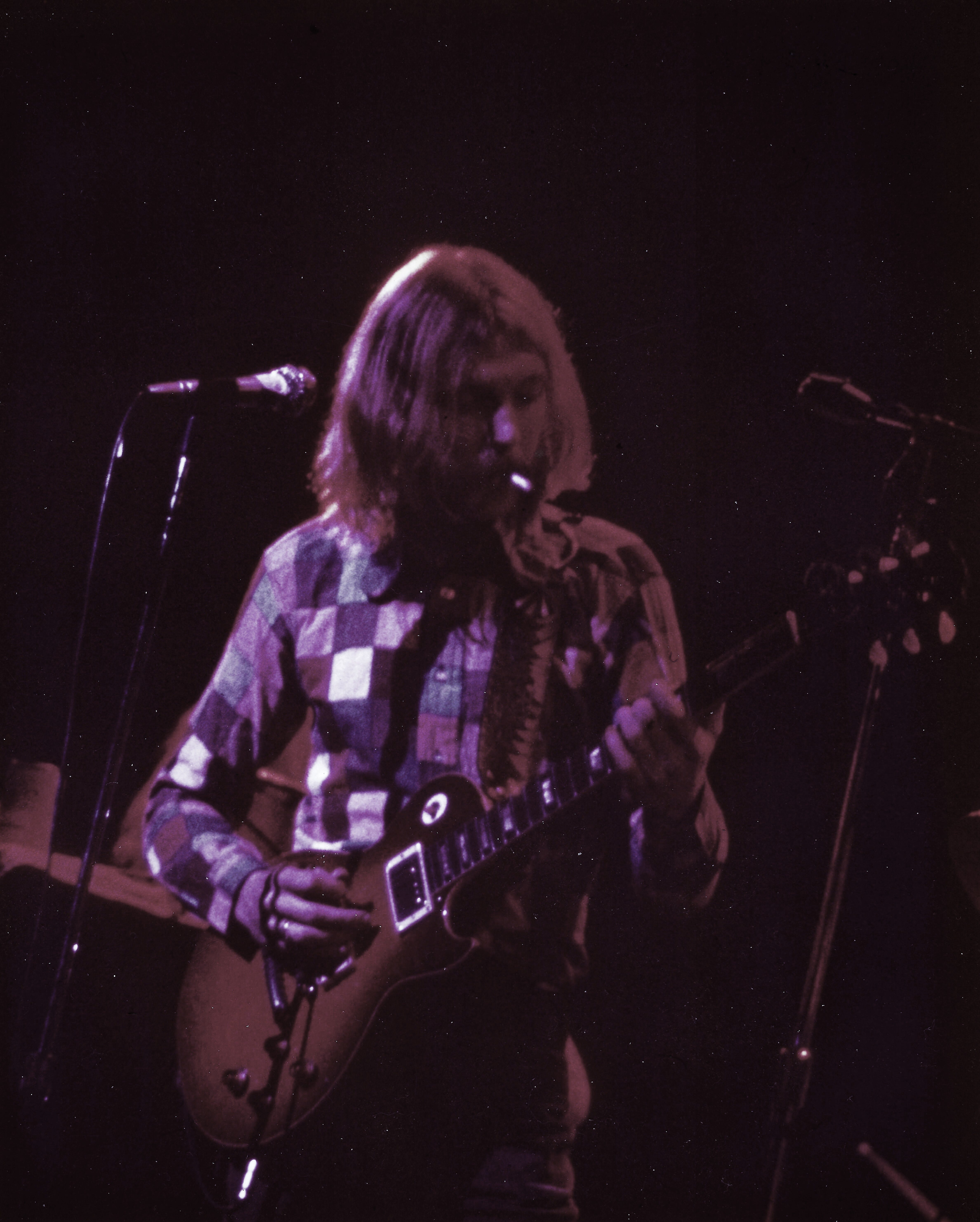
Duane at Fillmore East, 3/13/71 late show 📷Eddie Berman
The success of the album and the fact that it endures all these years later as part of the canon5 validates Duane, the band’s, and Walden’s instincts to issue a double album featuring the band in their most natural element: playing live.
Where the songs on the first two albums seemed clearly compartmentalized into blues, ambitious rock, and ballad, here the music is an eclectic whole, an entity.
Blues and ambitious rock are here, but At Fillmore East is definitely missing the ballad side of the Allman Brothers Band.6
Everything else is here. It really is the perfect representation of the Allman Brothers Band at that time in their career.
It is a machine cranked by hand, fueled by steam and wind, octane and electricity, discharging memory and surprise.
More great prose from Nolan. 55 years later we are still reaping the dividends of this magnificent album. And after 30+ years of my own listening to it, I’m still finding new things to hear. That is the mark of a great piece of art.
The group had headlined in certain Southern cities, but as the Fillmore set swiftly climbed the record charts their national status as a top-of-the-bill act was securely established. Now began, as well, the widespread critical acceptance which verified the band’s position among the hierarchy of rock.
Here’s Duane in July 1971:
“You’ll have to pardon me if I appear a bit swell-headed about this band, but I’m really proud of it, and it shames a lot of other bands I’ve ever heard. We’re a lot more serious about it than a lot of people are, and we work a lot harder at it than a lot of people do. It is very greatly evidenced every time we play with a band that is supposed to be some kind of hot shit. We’ve been putting them in the back seat every place we play and we’re going to keep on doing it because we like what we’re doing. We do it damn good and we’ve been at it a long time.”7
After 2+ LONG years as road dogs, the group was poised to seize the mantle as the country’s #1 band.
With At Fillmore East, they achieved the success that had theretofore eluded them.
Looking back, Jon Landau8summarizes the strengths and appeal of this group.
“The Allman Brothers were one of the few legitimate improvisatory American bands, one of the few rock bands that made a basically soloing style work. Every guy in that band could really play. And they could play together. That band could swing.
Their Fillmore album, from the first note to the last—you can’t even subdivide it into songs…it’s all there”
They were a band. Duane did not so dominate that group that they ceased to be a band, or became a vehicle for Duane Allman. It was one of the things he had most in mind when he conceived of the group; he wanted a band that he could play with, not over or against, or through. He wanted a group of partners, and that’s exactly what he got.
This last paragraph was an important part of my thesis in Play All Night.
Duane Allman’s artistic vision was a band of equals wailing in front of an enraptured audience.
Duane damn sure fulfilled that vision.
At Fillmore East is proof.
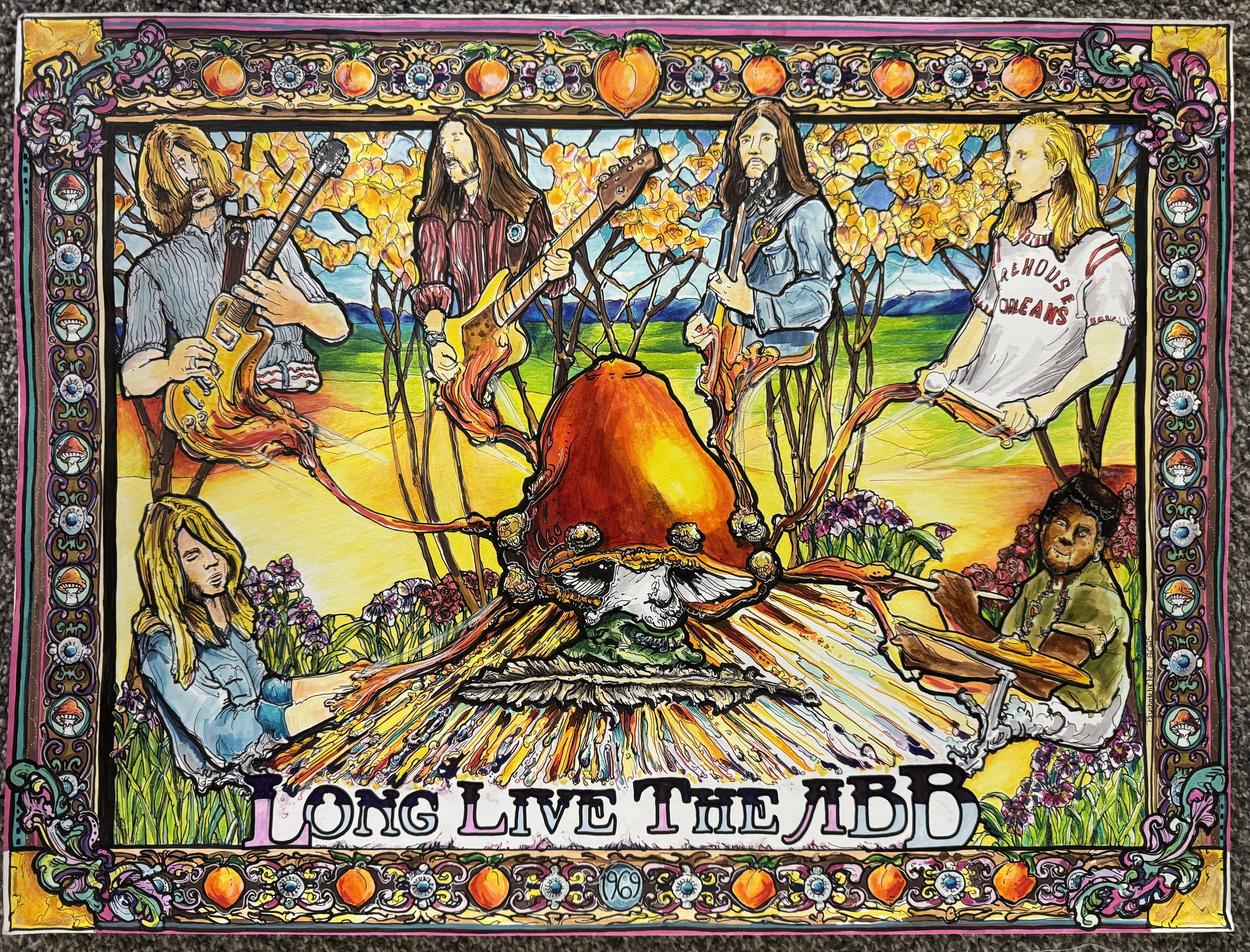
Artwork by Psychodelik Pete of photos in Play All Night.
Brought to you by the paid members of the Long Live the ABB community.
🍄MUSHROOM🍄MAGICIANS🍄 Steve Marshall, Brent W. Hammond, Ken Lupson, Laura McCarty
🍑 PEACH 🍑 PALS 🍑 Allen Barnes, Art Dobie, Baileys Mike, Bob and Laura, Bob Johnson, Brent Pruner, Bruce Miles, Buddy Lewis, Cabinetsales, Caroline Doolittle, charlie2541, Chuck Zumwalt, Clifford Morse, Craig Stephens, Cwktwo, Danbookin, Dennis Newton, Denny, Ed Ashton, Ed Pokorny, F. D., Frank Young, Gary Nagle/Chairman Wonwayout, Gary Smith, Gary Williamson, George Holman, Hlnbkt, Irishbeatz, James Reynolds, James Yerrill, Jcsarphie, JD Guitar, Jeff Kushmerek, Jeff Schein, Jerry K, JoaquinDinero, Joe Sokohl, Joel Berger, Joel Tanzer, John Delaney, John Dolan, John Haughey, Jordan David, Joseph Lilly, Kenton Lee, Kevin Harper, Kevin Walker, Kurt Nielsen, Mark Leitner, Martha Haynes, Mike Clark, Peter Poulos, Phillip Page, Preston Root, Randy Woodall, Ray Tillman, Robert Porter, Rose Brandt, sswoger, Stanleyglennie8, Surrender Cobra, Taylor Kropp, Tim Langan (Hot ‘Lanta Tim), Tina Christopher, Tom Pragliola, Tony Gioia, Wade McCurdy, Wiszowa
This was the first time I heard the term “the People’s Band,” which defines so beautifully the original ethos of the Allman Brothers Band and was a key part of Play All Night.
Play All Night! Duane Allman & the Journey to Fillmore East, 146. The relationship held together until 1972, when Walden and Wexler parted acrimoniously after Walden exercised an option to move Capricorn from Atlantic to Warner Brothers Records. Walden had learned the move from Wexler, who pulled a similar stunt on Jim Stewart at Stax in 1967.
As my dude Stevie Florida told me awhile back, “Don’t sleep on the studio version of ‘Liz Reed,’ it’s way better than you remember.” He’s right. It is.
I had an issue with this for years my dear friend, the late Bill “The Champ” Proudfoot, helped explain “Dreams” not being on the album. “Ol’ Duane just wanted to work on some other things on this one, Bobby.” He was spot-on, but they could’ve at least played it once that weekend, no?
“Duane Allman Of The Allman Brothers Band,” Argo vol 1, no. 4 (December 1971). Here’s the author’s notes for context: The following interview took place on that infamous tourist trap, the Steel Pier, Atlantic City, N. J. on July 7th. During that week the Allman Brothers Band captured two awards of distinction. First, they had been invited to play at the Newport Jazz Festival, and second, (and although more comic but just as important) they became the first hard rock band to play on Steel Pier. The band appeared to be having, as Duane Allman put it, ‘fun in spite of the place.’ Between sets, members of the band could be seen drifting around the pier, buying hot-rod t-shirts and hot dogs. It was Duane and drummer Butch Trucks who I finally managed to corner in their dressing room after dinner. Berry was my first contact with the band and had been extremely friendly, going out of his way to set up the interview. Therefore I would like to thank him, and mention it might be rewarding if, the next time you listen to one of the band’s albums, you direct your time and attention from the wailing guitars to his fine basslines. (In order to stop the flow of negative rumors about Duane’s personality, which might easily come as a result of reading this encounter, I would like to add that Duane had consumed a quantity of Southern Comfort before the interview.)