Episode Overview
Sean Gaillard discovered the Beatles in fifth grade when his British teacher demanded he listen to them as penance for foul language. When he first found the Allman Brothers, he saw Jaimoe front and center in the Brothers and Sisters gatefold.
These entry points were invitations, and Sean has spent a lifetime of practice around the idea that the music we love isn’t just soundtrack. It’s also instruction.
Sean is a teacher, school administrator, author, a podcaster, and music lover. He’s one of those people who moves seamlessly from Billy Preston to Butch Trucks to Booker T. and the MGs. He grew up in Winston-Salem, North Carolina, at the intersection of the Five Royales, R.E.M.’s early recording career, and a record collection his parents built on Motown and Sinatra. He found the Beatles on his own, on a borrowed copy of the Blue album, side one opening with “Strawberry Fields Forever.”
Sean’s framework—music as metaphor, music as leadership lesson, music as shared humanity—intersects so closely with my own, we often ride in parallel.
Our Crossroads
Years before we ever met, Sean and I locked in over the final half of “Mountain Jam” from Eat a Peach. We discuss this in minute detail1—the moment Butch comes in late, keeps playing until he finds where they are, and snaps back with intensity. That moment of recovery, of finding the note and holding it, is Sean’s leadership philosophy in miniature. It’s mine too, though I’d never framed it quite that cleanly before he did.
Sean is Black, grew up Catholic in a nearly all-white school in Winston-Salem, and was told more than once that the Beatles weren’t his music. His answer to that was to go find Chuck Berry and Little Richard in the Beatles’ liner notes, follow the chain, and arrive at a fully integrated understanding of American music that nobody could take away from him. It meant something to Sean when he saw Jaimoe on the cover of At Fillmore East. Same when he saw Billy Preston’s name on the back cover of Let It Be.
It meant something.
Sean traces a direct line from those moments to his career, his teaching, and the kind of leader he decided to become.
The Conversation
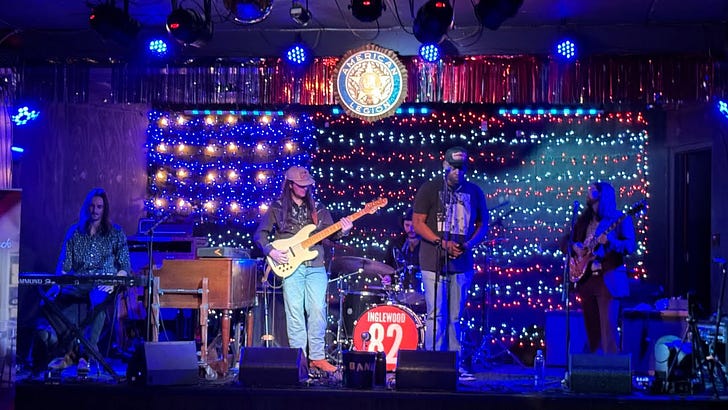
We open with Tedeschi Trucks Band performing “It Ain’t Fair”—Duane Allman’s track with Aretha Franklin—and that’s the right place to start, because this whole conversation is about what happens when people reach across the lines that are supposed to separate them and make something that belongs to everyone.
Sean’s entry into the Beatles came through a British teacher who assigned them as grammar medicine, a generous neighbor with the Red and Blue albums. A needle drop on “Strawberry Fields Forever” closed the deal. His entry into the Allman Brothers came through “Jessica,” then Brothers and Sisters, then Jaimoe’s presence on the gatefold—a Black man, front and center, not in the background, not credited as a sideman but as a founding member of a band from the Deep South.
Sean connects that directly to the band’s place in a larger story of integration: Duane convincing Wilson Pickett to cover “Hey Jude,” which put that slide guitar solo in front of Eric Clapton, which produced Layla.
The circle remains unbroken.
We talk about Hour Glass recording “Norwegian Wood”—Duane on electric sitar, a little Brubeck, a little Miles, the equation assembling itself before the band that would use it existed.2
We talk Gregg’s solo catalog, his unpolished gems, his amazing version of “Rain,” and Southern Blood. These are the conversations you can only have with someone who has listened as carefully as you have.
A Beatles thread weaves throughout.
Sean’s framework for John Lennon inviting Paul McCartney into the Quarrymen—recognizing a threat, choosing the band over the ego—is a sharp leadership argument. He applies the same lens to Duane assembling the Brothers: Butch’s classical precision, Oakley’s Mingus-inflected bass, Gregg’s voice as an instrument, Dickey’s second lead guitar, Jaimoe’s jazz. The band, not the individual, as the unit of analysis. These are lessons Sean has been teaching for thirty years.
We spend real time on representation—what it meant to Sean as a young Black kid in a mostly white Catholic school to find integration not as policy but as practice inside the music he loved. Billy Preston on the Let It Be sessions. Lamar Williams and Jaimoe on the Brothers and Sisters gatefold. Booker T. and the MGs. Arthur Lee and Love. More than mere symbols, they were evidence that walls are optional.
Of course we talk the South. Sean was born in California, raised in North Carolina, has lived in Boston, and has the particular relationship with the South that belongs to people who chose it—loving its pace and its music and its landscape while holding no illusions about what it has cost and keeps costing. His read on where we are right now is as clear-eyed and unsparing as anything I’ve heard said on this podcast.
We close on “Dreams”3—Dickey’s rhythm part, two chords, holding the groove while the whole thing opens up above it.
Sean plays it that way. That’s my goal as well.

Resources
Bob Beatty, Play All Night: Duane Allman and the Journey to Fillmore East—https://www.amazon.com/dp/0813069505.
Sean Gaillard—seangaillard.com
The Pepper Effect: Tap into the Magic of Creativity, Collaboration and Innovation
Vinyl Riffs with Sean Gaillard (podcast)

I have made it clear to my kids that I want the last half of “Mountain Jam” played at my funeral.
I noted that Warren Haynes teases “Norwegian Wood” and has for years. This is purely coincidence, I know, but it feels like another example of leaving the circle unbroken.