


Episode Overview
John Lynskey taught history at Miami’s Columbus High School for thirty years, coached for twenty, and served as assistant principal for seven. Upon retirement, he moved to Macon to work hands-on with the Big House Museum, where he had served on the board since day one. He has produced more than two dozen archival releases for the Allman Brothers Band, co-wrote Allman Joy: Keeping the Beat with Duane and Gregg with drummer Bill Connell, and spent two decades as a driving force behind Hittin’ the Note magazine.
But I knew John well before I knew of his connection to the Allman Brothers Band. In the early 1990s at UCF, some of my good buddies were Columbus guys, John’s guys. Lynskey was their history teacher and coach, full stop. Decades later, Mario sent a photo at John’s retirement. Talk about mushroom magic. Mario’s text arrived within minutes of it dawning on me that their beloved history teacher was John Lynskey, my fellow Allman Brothers historian and whose work I’ve been mining for decades.
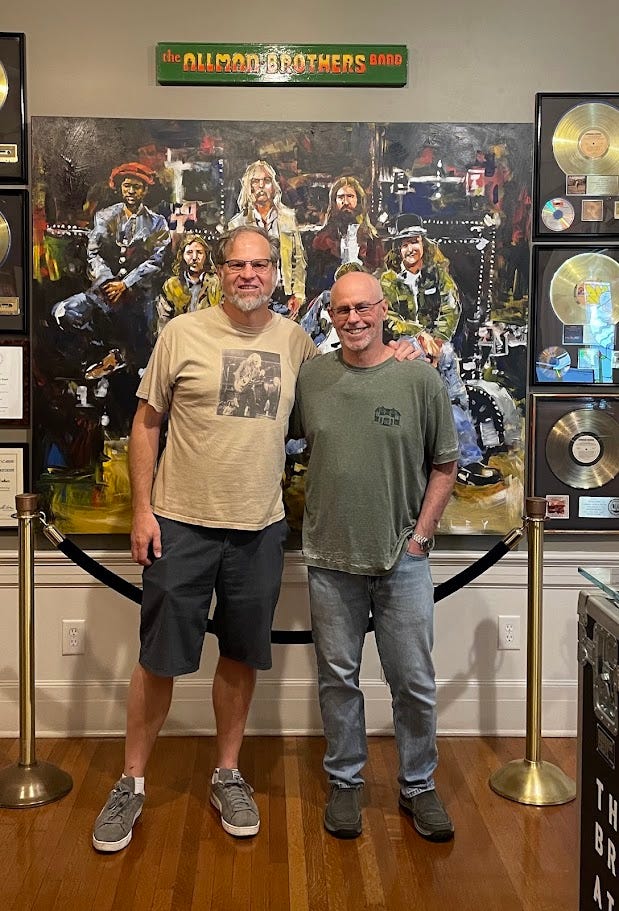
Our Crossroads
John and I share multiple intersections. We are historians who found the Allman Brothers Band through the music and grew fascinated with the entirety of their story. We both understand what it means to sit in an archive and chase a review that might not surface for five months after an album dropped. We believe music is a primary source, a band is a team, and community is what happens when like-minded people stop pretending they don’t need each other.
When I launched Play All Night in Miami in October 2022, John flew down to host an event. Like the teacher and coach he is, Lynskey teed me up to tell Duane’s remarkable story in a bookstore packed with his students. That night I met Abel Sanchez of MiamiStadium on Instagram, a sports, history, and culture site that became a model for my work at Long Live the ABB.
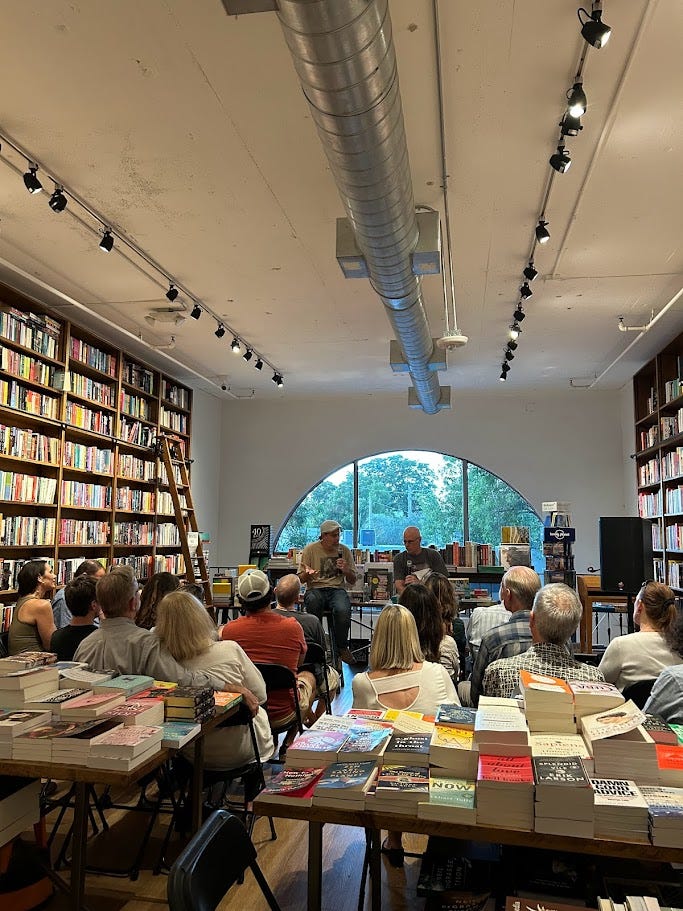
The Conversation
John talked about his journey from the classroom in Miami to the Big House in Macon. It’s the unbroken circle—from Columbus High School, a huddle on the football field, and the Allman Brothers Band dominating on stage. Brothers is a term that continually emerges in his life.
As South Florida natives, Miami was a foundation of our conversation. I grew up 100 miles up the road in Stuart, and my grandmother spent the 1920s in the area. Some of my formative memories of the “big” city were from visits to Miami.
John’s grandparents arrived in the early 1920s, one side from Savannah, the other from Huntsville, Alabama. He grew up in the mid-1970s version of the city—when Criteria Studios was cutting some of the greatest rock & roll ever recorded and the Dolphins were winning back-to-back Super Bowls at the Orange Bowl. He attended Super Bowls II and III. He played and coached in the Orange Bowl. He called it decrepit, uncomfortable, and a shrine all in one breath. I had the same impression as a youngster who first visited in the early 80s.1
The Miami Dolphins were important to both of us. John’s parents bought season tickets in year one. They dumped him and his siblings in the Huddle Club in the west end zone while they sat on the 50 yard line. He has memories similar to my own: the sound tumbling down from the closed end of the stadium, shaking the structure. Joe Robbie Stadium, where the Dolphins moved when they vacated the Orange Bowl, is beyond sterile in comparison.
John’s Allman Brothers origin story includes older kids in his neighborhood who dropped the needle and said, “Listen.” He landed on the Allman Brothers because of the intensity. Nobody played harder, with more passion, more purpose. Six guys playing as one. As a coach, he saw them as a team: everybody knew their role, everybody contributed, everybody supported. That framework held from 1969 to 2014.
We ranked the catalog the way nerds do. Enlightened Rogues—a Miami record, maybe the most underappreciated Allman Brothers album. Brothers of the Road—last, always, because it doesn’t have Jaimoe. Reach for the Sky only ahead of BotR because it does. Win, Lose or Draw saved from the bottom by “High Falls,” one of the most complex songs in the catalog and the seed of Sea Level.
John’s first Allman Brothers show was the Hollywood Sportatorium January 22, 1972.2 He was twelve and it was freezing. That is about all he remembers from what was surely a mind-blowing experience.
The show that hooked him for good was August 17, 1974 was at where else but the Orange Bowl? He was fourteen and his life has never been the same since.


