

The Mighty Mountain Jam
Any band that can hold my attention for 30 minutes, deserves it

I was DEEP into the Allman Brothers Band before I found “Mountain Jam.” The cuts I had encountered on A Decade of Hits 1969-1979 were groundbreaking enough for me.
I obsessed over “Dreams.” The song’s ethos of carrying on in the face of insurmountable mountains, has been a guiding force in my life. (See: https://www.longlivetheabb.com/p/dreams-part1.) It was my first “favorite” Allman Brothers Band song. Remains, with “Mountain Jam,” my favorite to this day.
The music consumed me, and I became enamored with the Allman Brothers Band’s story. There was a Southern Gothic quality to it that the Dreams box set captured brilliantly—Duane’s death just as they’re about to take off, Berry’s death a year later, and the band continuing on in each case.
The Allman Brothers reunited after touring on Dreams. They were active as a recording band, and, as always, made their name on stage. Music and guitar magazines said they’d found a new magic—something based on the foundation Duane Allman had long-before established for the band. One such publication was Guitar World. I can’t recall the issue, it was one of several Allman Brothers’ features they ran over the years, but this was on ABB history—two guys who years later have become friends: Alan Paul, the dean of ABB historians, and Kirk West, ABB Tour Mystic. Kirk commented “Mountain Jam” going on for 30+ minutes on a lark.
“Any band that can hold my attention for 30 minutes, deserves it,” I thought out loud.
That night, on break from my shift at Wunderbar at the Fashion Square Mall in Orlando, I walked to the music store and bought Eat a Peach on CD.
It started a lifelong love affair, one that’s shown zero signs of cooling. It is simply the most magical musical moment I have ever encountered. “Mountain Jam” speaks to my soul in ways I can never give words.
Shit, 90% of writing Play All Night was an attempt to explain “Mountain Jam” for myself. There are some moments in music that defy description. If you play with other people, you’ve surely felt it. The part when there is no separation from you and your instrument, you are communicating in a language your bandmates also understand, and they are also so keenly in tune with you, and you with them, that you seem to move as if one.
That’s what I hear when I listen to “Mountain Jam.”
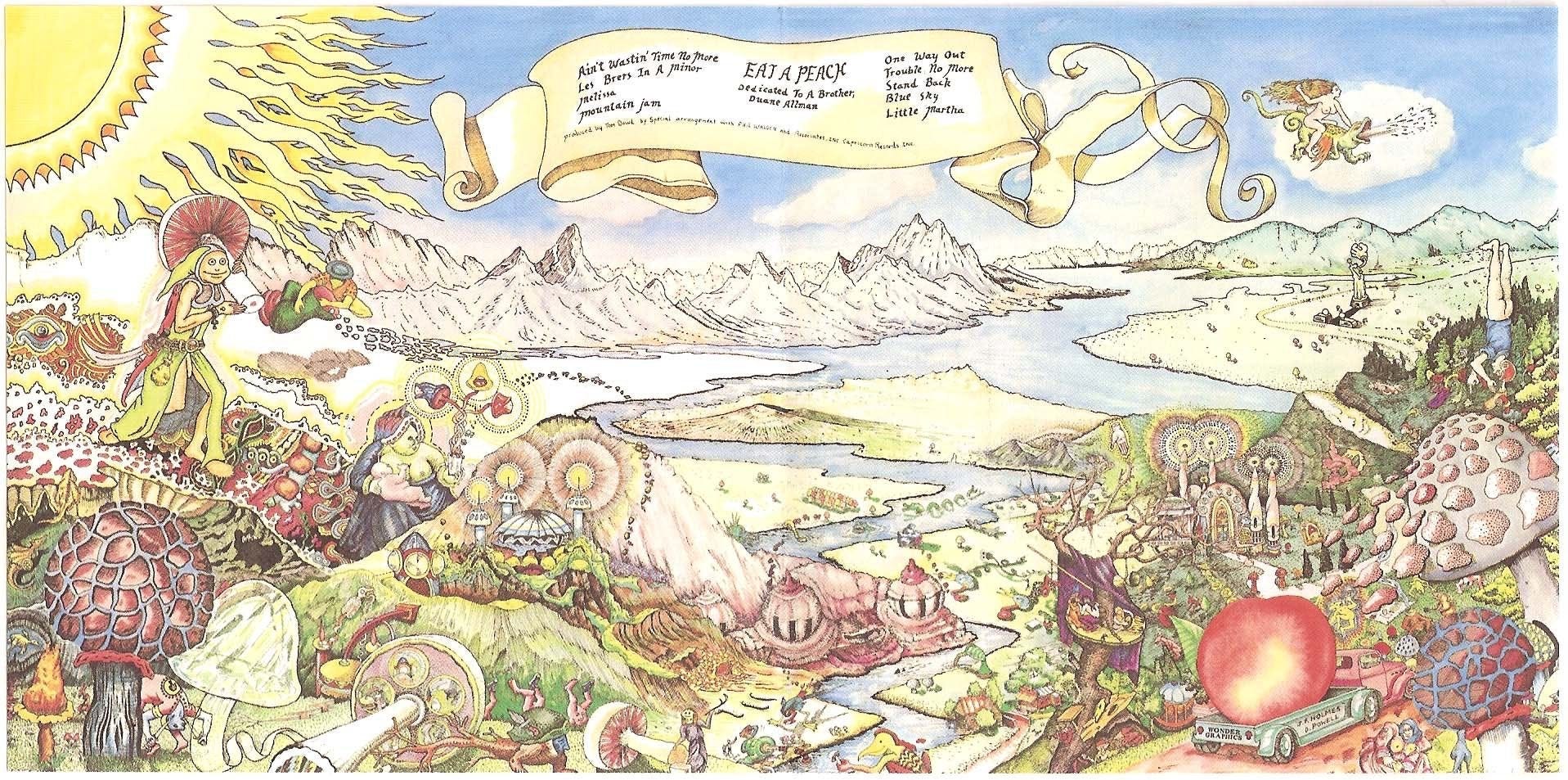
“Mountain Jam” is my favorite 33-minutes of music of all-time. I have told my children I want the back half of “Mountain Jam” played at my funeral—from Duane’s count-off to the end. Because it’s what Heaven sounds like to me. (Which fits, because what I imagine Heaven to look like is the image in the Eat a Peach gatefold.)
This post is brought to you by two fantastic music publications.
Stories from the Jukebox and A Song For You, by MJ Polk and Sammy Criscitello, respectively.
Stories from the Jukebox is a weekly writing prompt that MJ Polk posts and curates. “Mountain Jam” is this week’s headliner. Here’s how to join the fun:
Calling all Poets, Fiction, and Non-Fiction writers that love music — Share your prose of 1500 words or less, using the prompt, Mountain Jam.

And stay tuned for a guest post this Sunday on A Song For You—a music storytelling series that dives into connections to the songs that shape our lives. “Mountain Jam” is the topic there too.
Excerpt from Play All Night! Duane Allman and the Journey to Fillmore East

“Berry Oakley, Dickey Betts, Butch Trucks, Jai Johanny Johanson, Gregg Allman, I’m Duane Allman!”
Duane’s emotional introduction of his band concluded nearly an hour of nonstop music playing just two songs, “Whipping Post,” a ferocious psychedelic blues and “Mountain Jam,” a tour-de-force instrumental based on Donovan’s “There Is a Mountain.”
“Mountain Jam” closed a five-show run at Bill Graham’s Fillmore East. Four of the March 1971 shows served as sessions for the band’s third album, At Fillmore East, whose success validated Duane’s pursuit of musical excellence on his own terms in a music business that prioritized conformity and record sales over individuality and live performance.
At Fillmore East appeared just two years after Duane turned his back on a successful career as a studio guitarist to develop a band focused on musical virtuosity and improvisation, qualities best presented live. Duane forged an uncompromising musical path as the ABB’s front man despite neither singing nor writing. And Duane, a white man, made this journey in an integrated band from the South, a group of fellow southerners whose sound melded strains of southern music in ways that reflected a collective vision of music and its possibilities.
Improvisation, virtuosity, and live, organic, communal, experience are what Duane Allman valued most in music. It took him time to sift out these values, put them into action with the Allman Brothers Band, and capture the dynamic on record.
These qualities are all in abundance on “Mountain Jam.”
The song is one of the earliest in the repertoire. But to call “Mountain Jam” a song is a misnomer. It’s a jam in the truest sense of the word. It begins with the group toying with Donovan’s melody in “There is a Mountain” before they lock into a groove that is entirely their own.
“It was literally a jam that turned into a song,” Betts recalled. Gregg said, “We just started playing it one day, a happy little melody and it makes for a really nice jam.”1
“Mountain Jam” is twelve-minutes at Macon’s Central City Park on May 4, 1969.2 In less than a year, the band stretched out the song beyond thirty minutes, including multiple movements and solos from all six members.
Donovan’s simple pop song provided a platform for the band’s explorations and influences. “Mountain Jam” is a conversation. Duane would quote “Shortnin’ Bread,” a nineteenth-century folk song, which, Jaimoe remembered, prompted “Dickey’s melody that answered and made statements in response to Duane’s melody.”
Said Butch, “Duane would start playing, and as soon as Dickey would hear something, that would trigger something in him, Dickey would jump right in and start playing along. Neither one of them were playing guitar solos. Duane would start the conversation, and Dickey would join in the conversation. We all would. And then we’d see where it would go. And every night it would go to a different place.”3
On many nights, including the version from Eat a Peach, Duane’s outro solo featured the Carter Family standard “Will the Circle Be Unbroken” as the song wound down.
It’s in this moment listeners can hear the closeness of the musicians in their musical conversations, each improvising his part, whether soloing, comping, or both simultaneously. “What made that weekend special is that we had been out on the road, we’d been playing these songs, and you know how sometimes, everything comes together at the right time? When you have the right people in the right place doing the right thing?” Butch Trucks reflected. “We were really comfortable with these songs that we were playing. On ‘Whipping Post’ and ‘Mountain Jam,’ we had really learned to talk to each other. By the time that weekend came along, we were really communicating.”
“Mountain Jam” closed out the ABB’s three-night run at Fillmore East in March 1971. You can hear its opening notes as the band chugs the band forward out of “Whipping Post.” The track fades out, closing At Fillmore East. “Mountain Jam” would appear the next year on Eat a Peach, covering sides 2 and 4 of the LP.
Berry Oakley
Berry Oakley didn’t get many bass solos with the Allman Brothers Band. (ABBassists typically get one spot a night.) But he’s really soloing all night. And nowhere is this more evident than on “Mountain Jam.”
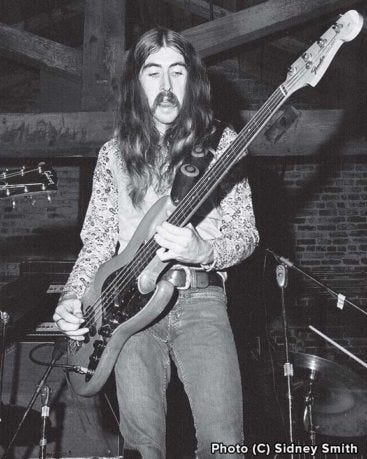
Berry amazes me. I hear so much push-and-pull, call-and-response. I love the way he drives the band in answering what the soloists are doing. The ABB catalog is packed with Berry Oakley greatness; “Mountain Jam” is among my favorites.
The 33-minute jam evolves out of “Whipping Post”—Butch thundering on tympani with Jaimoe’s drums. Berry’s bass weaves in, out, around, under, and through as Duane, Dickey, and Gregg toy with the melody before they announce the theme: Donovan’s “There is a Mountain.”
Some of my ABBsolute favorite playing of Berry’s is in the first half of “Mountain Jam,”3 where Berry and Dickey are parrying and thrusting.
Dickey’s solo starts about 7:27 and the two of them gallop along along together…
About 9:02-ish, they begin a new conversation. Dickey will say something, Berry answers in a way that prods Betts along.
They go along like this for a minute and about 10:14, Dickey, Berry, and Duane begin a three-part harmony.
The jam takes a turn at 11:00ish and begins a 2+ minute stretch of some of my favorite Allman Brothers playing of all time. The band provides everything Dickey and Berry need to soar. Duane lays down rhythm and short lead riffs over rock solid drums. Gregg slathers B3 gravy all over everything. Everyone’s hittin’ the note, individually and collectively.
And that final 1:20 going into the drum jam is not just Dickey’s gorgeous, melodic bit of momentary composition. Berry Oakley is writing that brilliant piece of music right along with him.
“Mountain Jam” is a masterwork of momentary composition.
The six musicians created an entirely new piece of music from Donovan’s simple song, a fully improvised jam with multiple movements and solos from each band member, including a drum duet between Trucks and Jaimoe. Berry Oakley transitions the drum/bass jam to a thundering cadence of notes, Duane, Dickey, and Gregg join back in, the next five minutes are some of the finest musical communication the Allman Brothers Band ever recorded. They are so in sync, the result sounds less like improvisation and more like a classical music ensemble. Listening almost feels like eavesdropping on an intense conversation; the music sounds that intimate.
Brought to you by the paid members of the Long Live the ABB community.
MUSHROOM MAGICIANS: Steve Marshall, Brent W. Hammond, Ken Lupson, Laura McCarty
PAID MEMBERS: Allen Barnes, Baileys Mike, sswoger, Bob Johnson, Bruce Miles, Buddy Lewis, Caroline Doolittle, Chuck Zumwalt, Clifford Morse, Craig Stephens, Dennis Newton, Denny, Ed Ashton, Ed Pokorny, F. D., Frank Young, Gary Wonwayout, Gary Williamson, George Holman, James Reynolds, James Yerrill, JD Guitar, Jeff Kushmerek, Jeff Schein, Jerry K, JoaquinDinero, Joe, Joe Sokohl, Joel Berger, Joel Tanzer, John Dolan, John Haughey, Jordan David, Joseph Lilly, Kenton Lee, Kevin Walker, Kurt Nielsen, Long Live the ABB, Mark Leitner, Martha Haynes, Peter Poulos, Phillip Page, Preston Root, Randy Woodall, Ray Tillman, Robert Porter, Rose Brandt, Surrender Cobra, Taylor Kropp, Tim Langan (Hot ‘Lanta Tim), Tina Christopher, Tom Pragliola, Tony Gioia, Wade McCurdy, Bob and Laura, Gary Smith, Wiszowa, Cwktwo, Hlnbkt, Cabinetsales, Art Dobie, Stanleyglennie8, Danbookin, Buddy Lewis, Kevin Harper, Charlie2541
Here’s a recording from May 4, 1969 in Macon:

The Donovan song was all over the radio in 1968/9. Some folks (not me) think the Allmans picked up the idea from Jerry Garcia, who briefly quoted the melody in “Alligator” on the Dead’s Anthem of the Sun. It’s just as likely, as Richard Brent of the Big House has suggested, Herbie Mann’s version from 1968.
Jon Dale, “Butch Trucks on the Allman’s Wild Times at the Fillmore East,” Uncut 9/14/14.

SWAG
Jimmy Carter. I’ve always loved this Walt McNamee shot of then-candidate Jimmy Carter in an Allman Brothers shirt. Carter is speaking to reporters July 4 weekend 1976, shortly after the band’s break-up and Gregg’s testimony in a federal drug case. I tagged the barn in the back with Long Live the ABB shroom 2 from Psychodelik Pete.

Fillmore East ad. This is an adaptation of an original newspaper advertisement for the original Fillmore East recording sessions. I replaced Johnny Winter’s face with the LLtABB shroom and moved the Allman Brothers to the TOP of the bill, a spot they EARNED after Johnny Winter demanded they switch places because he didn’t want to follow them.

Mountain Jam is my fav too. There's at least one at 45 minutes on some bootlegs.
Mighty indeed,your use of that adjective fits it perfectly. 🎶✌️🍄🎵🎸🍄🟫☮️