“Some of the greatest live performances I’ve ever witnessed” The Allman Brothers Band's At Fillmore East at 55
The Allman Brothers Band released At Fillmore East on July 6, 1971. On the album’s 55th anniversary, I am serializing excerpts from Play All Night! Duane Allman & the Journey to Fillmore East, which I call the biography of a sound. The sound of the Allman Brothers Band at their artistic height.
Everything was on the line for Duane and the Allman Brothers Band with At Fillmore East. Everything. The decision to release a live album was not as obvious as it might seem on the surface.
This is part two of four, Recording At Fillmore East (March 11-13, 1971)
Part 1
The At Fillmore East sessions spanned five shows over three nights, March 11 through 13, 1971.
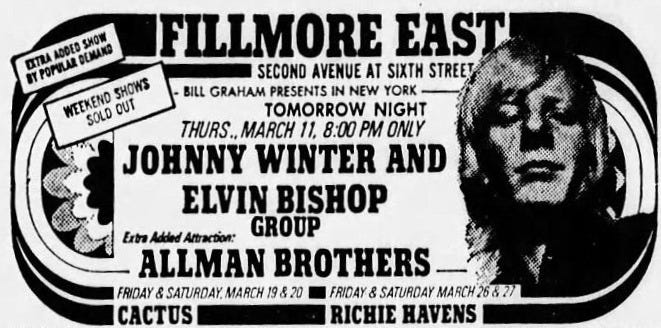
Tapes survive for the latter four shows. The Allman Brothers were not the scheduled headliner; they had the middle slot on a bill between headliner Johnny Winter and opener the Elvin Bishop Group.
“The ABB tore into the early show like it was a Friday night late show,” Alan Arkush recalled. The energy stunned Winter. “Johnny wanted to reverse the order,” Arkush said. “He just couldn’t top them.” Winter’s manager insisted the bands switch slots. “Johnny is gonna be opening for the Allman Brothers from now on because we can’t have that happen again,” Trucks overheard after Friday’s early show, which is exactly what happened. Johnny Winter demanded they switch places, and he played the middle slot for the rest of the run.1
The lineup change gave the ABB the liberty to do what it did best, improvise and expand songs as the muse struck. Graham’s bills afforded about sixty minutes to the middle act, not nearly enough time for a band that topped that number with only four songs on At Fillmore East: “You Don’t Love Me” (19:06), “Whipping Post” (22:40), “In Memory of Elizabeth Reed” (12:46), and “Stormy Monday” (8:31). If the lineup order hadn’t switched, Butch recalled, “we absolutely wouldn’t have had all that time to do all the stretching out that led to At Fillmore East.”
The Fillmore East sessions caught a band “entering its prime as a performing unit,” wrote Bud Scoppa. They arrived in New York well-rehearsed and in top form. Arkush said, “The Saturday night shows, early and late, were probably the greatest I ever saw the Allman Brothers play, one of the greatest live performances I’ve ever witnessed.” The bulk of At Fillmore East came from these two shows.
At Fillmore East was a carefully planned and brilliantly executed documentation of the band’s development. Listeners can hear the closeness of the musicians in their musical conversations, each improvising his part, whether soloing, comping, or both simultaneously. “What made that weekend special is that we had been out on the road, we’d been playing these songs, and you know how sometimes, everything comes together at the right time? When you have the right people in the right place doing the right thing?” Butch reflected. “We were really comfortable with these songs that we were playing. On ‘Whipping Post’ and ‘Mountain Jam,’ we had really learned to talk to each other. By the time that weekend came along, we were really communicating.”
“We knew those shows were special,” Jaimoe said, “but when you’re doing it and you’re in the middle of it, you’re not thinking like that. Great stuff was going on. I didn’t want to get hung up over knowing the shows were being recorded. That would not be good, you need to get your mind off of that so you don’t get hung up and forget what you’re supposed to be doing, which is playing music and connecting with an audience.”
The sessions feature six musicians in deep, constant musical conversation in front of an appreciative audience.
Duane’s and Dickey’s guitars are the most prominent in conversation, but the third guitar, Berry’s bass, drives nearly all of it. His runs answer his bandmates’ with ideas of his own that spur the entire band in new directions. On Hammond B-3, Gregg is as active as he would ever be in his Allman Brothers Band career, laying down a steady base of sound. Firming up the foundation is an unshakeable rhythmic foundation. The power of the drums is one of the most noticeable differences between Idlewild South and At Fillmore East. Jaimoe plays as much percussion on Idlewild as he does drums, which may be another reason it didn’t sell as well as hoped. Jaimoe is a drummer. And the Allman Brothers was a two-drummer band. The double drumming on At Fillmore East makes the rhythm more forceful, which seemed to give the band confidence.
The Fillmore East recordings captured a group at the peak of its powers. “We were a hell of a band,” Betts said, “and we just got a good recording that captured what we sounded like.” Trucks recalled, “We knew each other well enough, we knew the material well enough to where we didn’t have to think about it and could let it all flow so naturally. We knew what each other was going to do—yet we were constantly wide open to letting it go and taking a dive and seeing what would happen.” Jaimoe said, “You went by what the song was dictating as opposed to thinking it out.”
As in jazz, the songs were “structured to the point where we’d know who went first,” Betts recalled, “but what was going to happen in the middle of it, we never knew.” Duane, as bandleader, would count off songs, Gregg said. “We would end it when he raised his hand, but in between, the band just let itself go wherever the music would take us.” Tunes morphed accordingly, stretching to whatever limits the band and soloist felt in the moment, which Jaimoe cited as Coltrane’s influence. “With whatever amount of space you have to do something, that’s what you have and the ability to do that just shows the mastery of knowing what you’re doing, how to develop it and how to play a song.”
The Fillmore East audience was among the ABB’s most attentive. “They would kind of play along with us,” Gregg recalled. “We’d go from two decibels to a hundred. But when we shut down, they’d shut down. They’d go from screaming and yelling to absolute silence. They were right on top of every single vibration coming from the stage.” Dowd captured the vibe well on the recording. Twice on “You Don’t Love Me,” for example, the band dropped out altogether, leaving Duane soloing alone on stage. Both times, the crowd remained nearly still, as if stirring would disturb the magic. The second time it happened, one dude could hold back no longer. “Play all night!” he burst out, in one of the most famous, joyful fan moments captured live. Duane teased the eighteenth-century Christmas carol “Joy to the World” to signal the end of his solo. Dickey is first to pick up the cue. The band followed, as the guitarists steered the song’s thundering conclusion.
The Allman Brothers Band played five shows over the course of the Fillmore East sessions. Recordings remain of four: the early and late shows on March 12 and 13. For the March 11 shows, Duane had invited a three-person horn section including Jaimoe’s friend Juicy Carter to guest on a few songs. Following the March 11 early show, Dowd told Duane to cancel the experiment. “This isn’t the time to try this out,” he argued. Dowd was adamant, and correct, that the unrehearsed and out-of-tune horn section did not belong on the album. Carter demonstrated little feel for the Allman Brothers Band’s music, and though he joined the band at least twice more over the weekend, none of the horn section’s appearances made the final album.
Convincing Duane to excise the out-of-place jazz horn section from the At Fillmore East sessions was one of Dowd’s most important contributions to the album.
It gave the world a note-perfect, horn-free “In Memory of Elizabeth Reed” that is a highlight of the record and among the greatest pieces of music the Allman Brothers ever recorded.2 The suggestion is even more remarkable considering Dowd wasn’t even supposed to be in New York for the sessions. He was in Ghana working on the film Soul to Soul and had planned a brief vacation before he changed his mind and flew home to New York instead. He called Atlantic when he landed and learned the Allman Brothers were in town recording. He headed straight to Fillmore East.
Given the album’s high stakes, the serendipity is puzzling. The band chose not to record in New Orleans on New Year’s Eve 1970 because Dowd wasn’t available, so why then would they book the Fillmore East for recording without their producer? More than likely, the group decided recording at the Fillmore in March 1971 was more important than Dowd’s presence at the sessions. Dowd and the Allman Brothers had worked closely together for a year, and they knew the songs were ready. Once the band started playing live, the producer’s role is less essential. Engineers did the recording, And this was another bonus of having Dowd: his engineering. It is a brilliant recording that sounds expansive and intimate all at the same time.
The Allman Brothers Band played tight set lists over the weekend. By 1971 sets had formalized to the extent that shows began with the songs Duane played on slide.3 At the Fillmore, this meant four short blues songs: “Statesboro Blues,” “Trouble No More,” “Don’t Keep Me Wonderin’,” and “Done Somebody Wrong.” Two of the tracks, “Statesboro Blues” and Elmore James’s “Done Somebody Wrong,” had yet to appear on an Allman Brothers release, though the band had attempted to record the former several times in the studio.
Betts’s “In Memory of Elizabeth Reed,” recorded at the early show Saturday, March 13, is the definitive version of the band’s definitive instrumental.
The two guitarists are in command of their instruments, as Betts and Allman confidently channel jazz influence and blues roots in extended solos, with Duane bringing his solo to two climaxes. The Fillmore East version is a masterwork, six band members in sync through multiple melodic and tempo changes. A second instrumental, the up-tempo, jazzy “Hot ’Lanta,” is the sole full-band co-write. It is the only Allman Brothers instrumental that never appeared on a studio album and that the band never stretched out on stage.
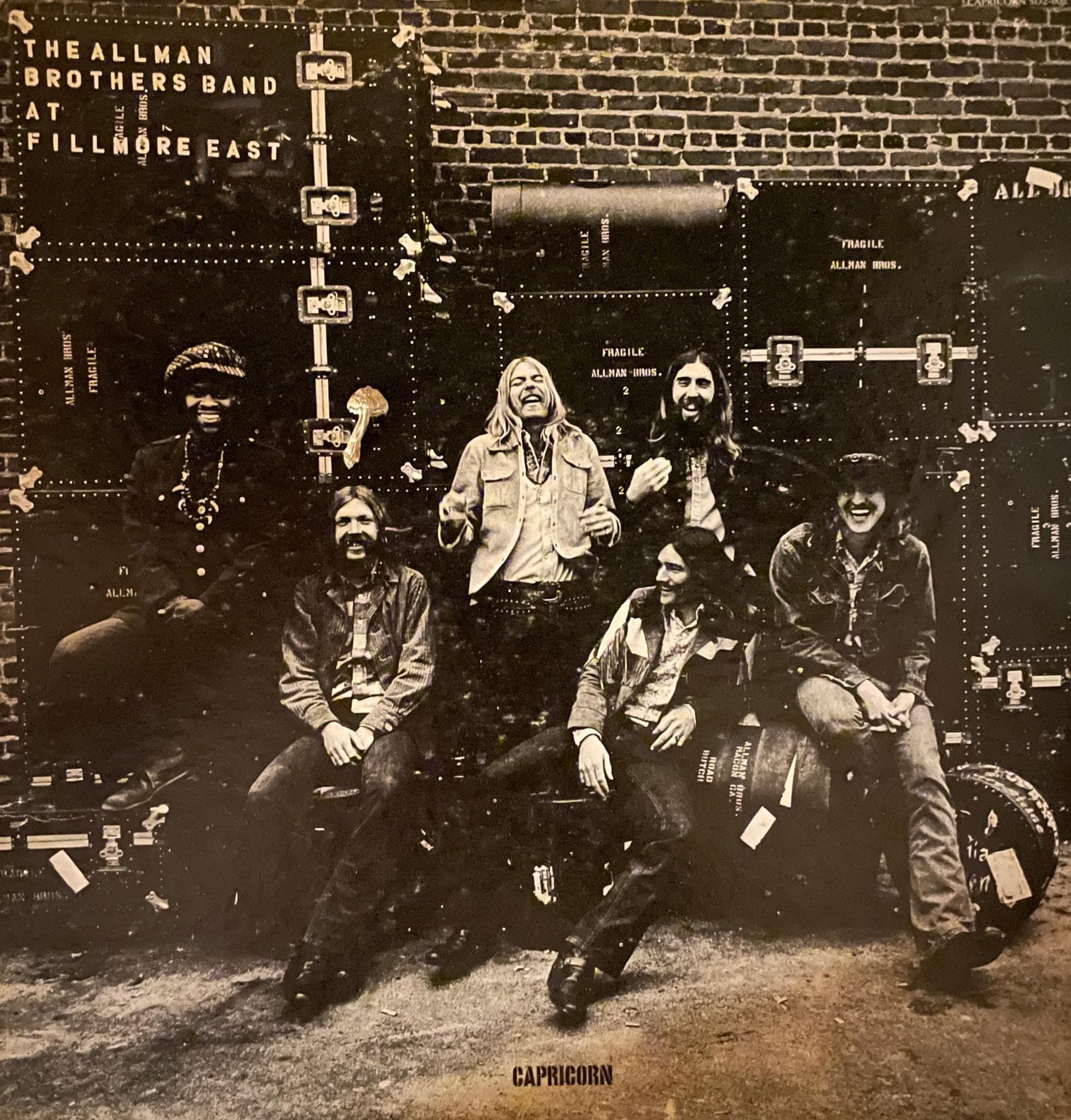
The band played “Stormy Monday” just once over the weekend, the Saturday late show, a performance that made the final album. The Allman Brothers made “You Don’t Love Me” (Willie Cobbs by way of Junior Wells) their own—a twenty minute take from a patch of two versions. “Whipping Post” closed the album, but not the sessions. As the album fades out, you hear the opening notes of one last song, “Mountain Jam.” The jam was a fitting end to a triumphal weekend. The thirty-plus-minute improvisation featured solos from all band members, including a three-minute drum jam.
“Sure has been a fine weekend,” Berry Oakley exclaimed at the jam’s conclusion.
“Fine weekend” was an understatement. The music the band recorded at Fillmore East March 12 and 13, 1971, was a band in its element, playing at an absolute peak. And the group knew it. “Last weekend we played in New York,” Oakley announced from the Warehouse stage the following week. “We recorded four different shows, and we got enough material that sounds a lot like the really spaced-out stuff that we do when we get down here and we’re gonna put it out on record in about six weeks.”
Capricorn released At Fillmore East less than four months after the sessions, on July 6. By September 3, it reached number 13 on the Billboard charts. By October 25, At Fillmore East had sold 500,000 copies. The Allman Brothers Band had their commercial breakthrough.
Excerpted from
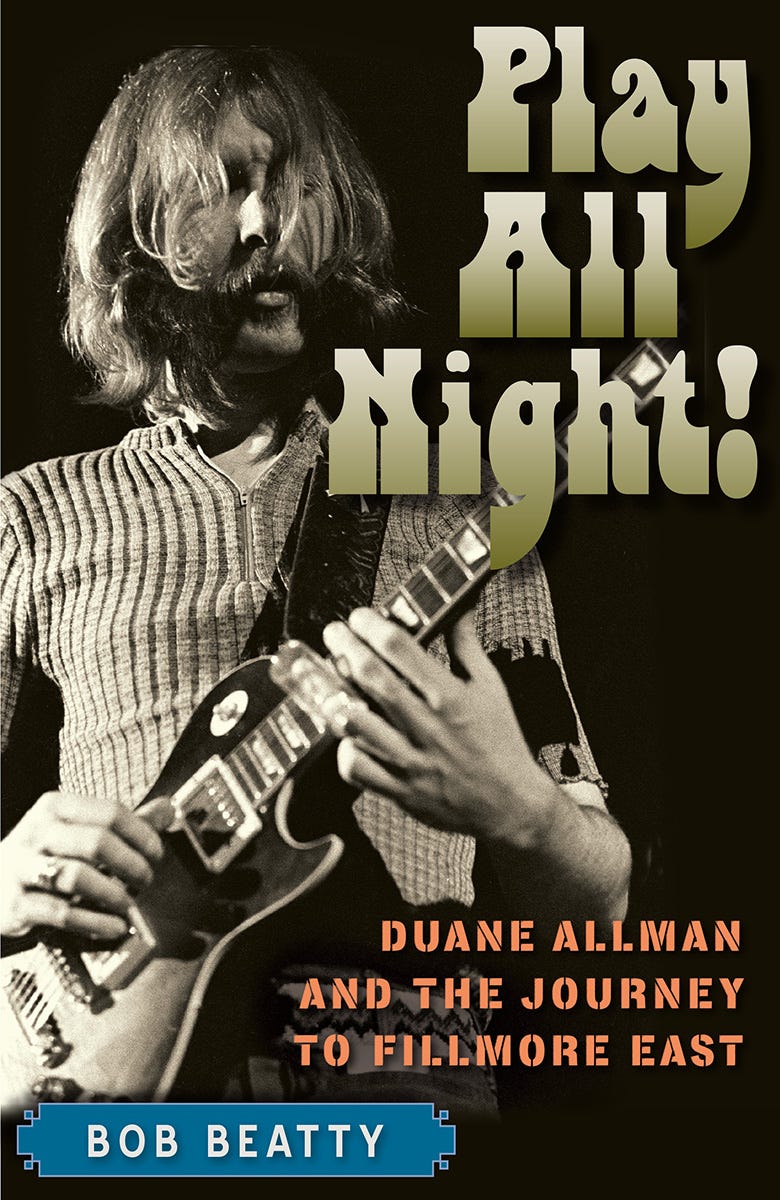
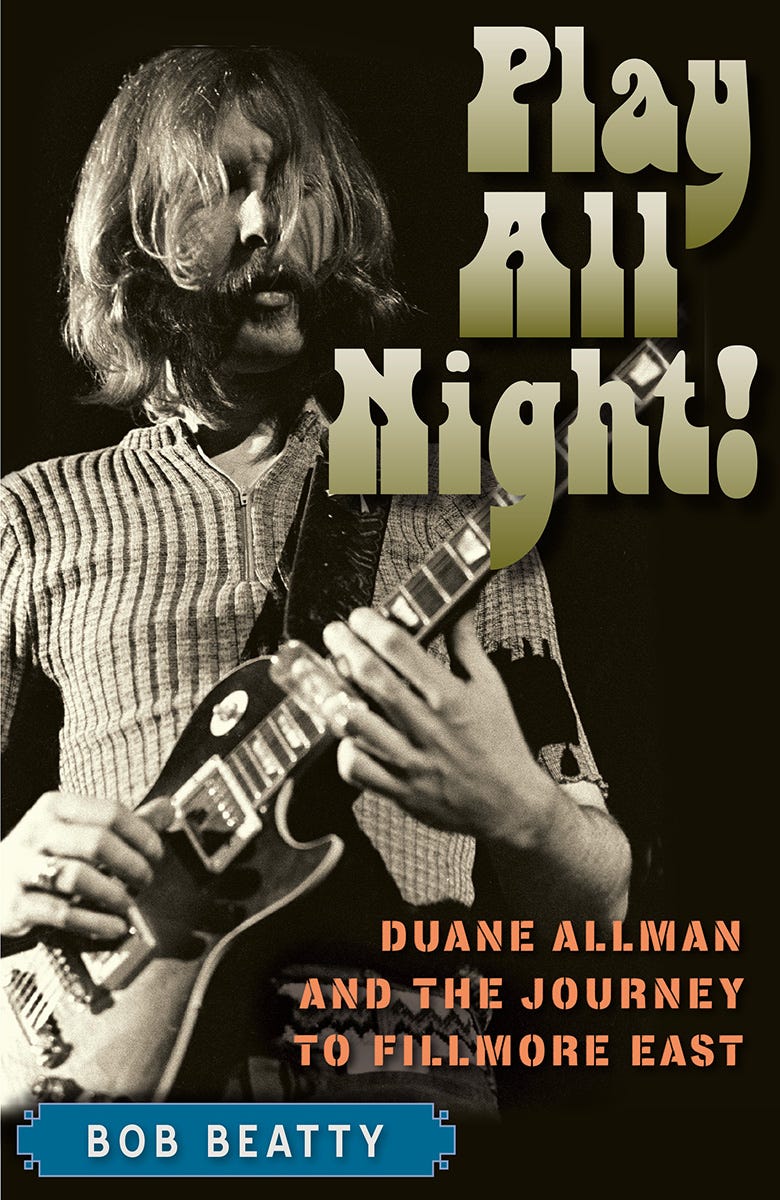
🍄Play All Night! Duane Allman the Journey to Fillmore East🍄
When you care enough to send the very best.
Share this post.
Remember, sharing is caring.
Lagniappe
A video short of some photos from Friday, March 12 early show. The photographer, Richard Edelman, remembers Johnny Winter watching the ABB’s set from the wings, which is apparently when Winter decided he didn’t want to follow the Allman Brothers that weekend.
And a playlist to accompany you on your journey

Brought to you by the paid members of the Long Live the ABB community.
🍄MUSHROOM🍄MAGICIANS🍄 Brent W. Hammond, Craig Stevens, Ken Lupson, Laura McCarty, Steve Marshall
🍑 PEACH 🍑 PALS 🍑 Allen Barnes, Art Dobie, Baileys Mike, Bob and Laura, Bob Johnson, Brent Pruner, Bruce Miles, Buddy Lewis, Cabinetsales, Caroline Doolittle, charlie2541, Chuck Zumwalt, Clifford Morse, Craig Stephens, Cwktwo, Danbookin, Dennis Newton, Denny, Ed Ashton, Ed Pokorny, F. D., Frank Young, Gary Nagle/Chairman Wonwayout, Gary Smith, Gary Williamson, George Holman, Hlnbkt, Irishbeatz, James Reynolds, James Yerrill, Jcsarphie, JD Guitar, Jeff Kushmerek, Jeff Schein, Jerry K, JoaquinDinero, Joe Sokohl, Joel Berger, Joel Tanzer, John Delaney, John Dolan, John Haughey, Jordan David, Joseph Lilly, Kenton Lee, Kevin Harper, Kevin Walker, Kurt Nielsen, Mark Leitner, Martha Haynes, Mike Clark, Peter Poulos, Phillip Page, Preston Root, Randy Woodall, Ray Tillman, Robert Porter, Rose Brandt, Scott Green, sswoger, Stanleyglennie8, Surrender Cobra, Taylor Kropp, Tim Langan (Hot ‘Lanta Tim), Tina Christopher, Tom Pragliola, Tony Gioia, Wade McCurdy, Wiszowa

Duane seemed to have a bit of a rivalry with Winter and this must’ve been really satisfying to him. Read more here:

Backstory on the namesake of Dickey Betts’s greatest instrumental.

My take on the static 1971 setlists: the band was rehearsing for then playing the shit out of their new album.

🍄🍑MERCH🍑🍄
Created this to honor the Allman Brothers Band’s March 1971 run at Fillmore East. You’ll see the original ad below, which had Johnny Winter at the top of the bill.


Here’s the original ad. I moved the Allman Brothers to the top of the bill, and replaced Winter’s photo with Long Live the ABB shroom #2 by Psychodelik Pete/Peter Nogas.