

"Mother, I would go hungry to play this guitar" The making of Duane Allman
The Allman Brothers Band: A Biography in Words and Pictures marginalia series part 1
Reading Tom Nolan’s The Allman Brothers Band: A Biography in Words and Pictures (1975) sends my brain in all kinds of different directions, little tangents that y’all may find interesting.1
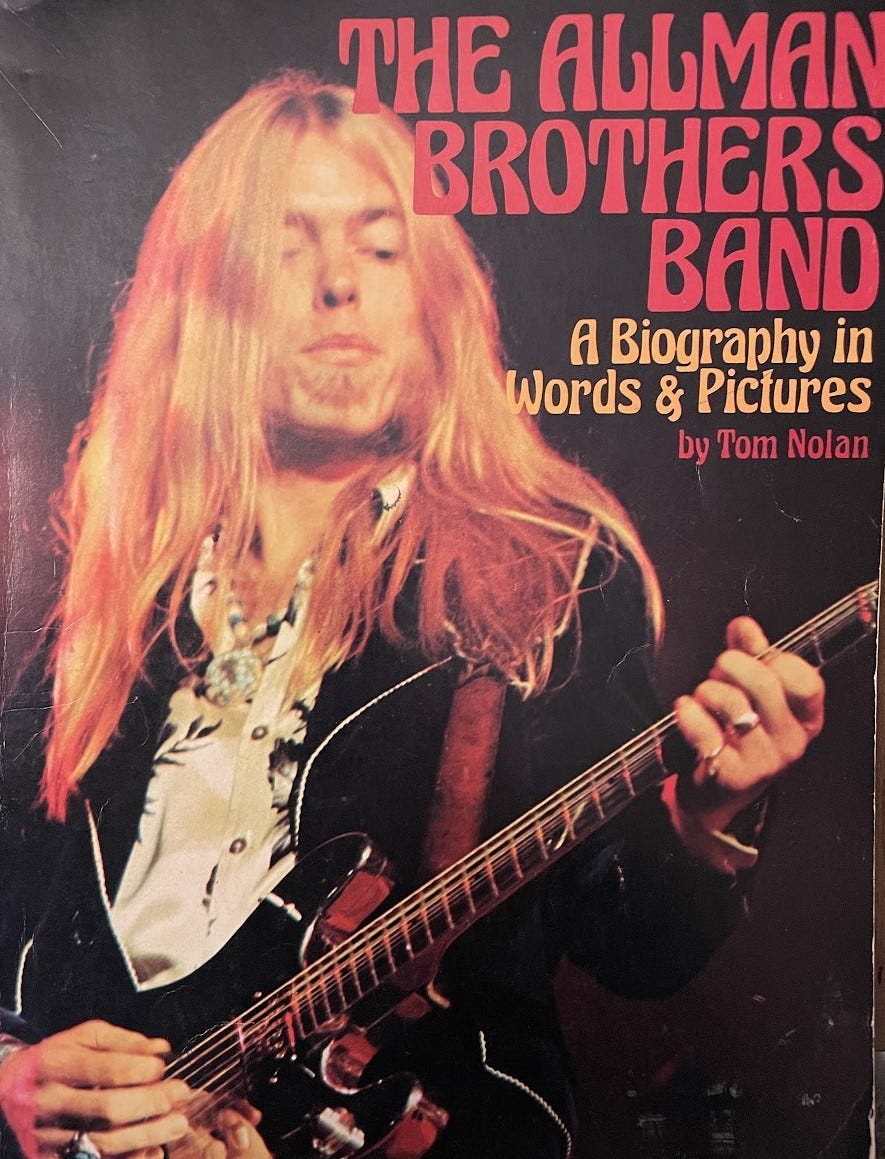
Out of print since its first print run in 1975, the book is packed with ABBsolute gems. Nolan’s interviews with the band and crew right before the first break-up are insightful. So too is his commentary on the band’s ascent.
The Allman Brothers Band: A Biography in Words and Pictures has long been an essential source for me.
Here’s part 1 of my marginalia series.
I did my best to organize this visually for you.
The original text looks like this.
My comments look like this.
I’ll start from the beginning…
Acknowledgments
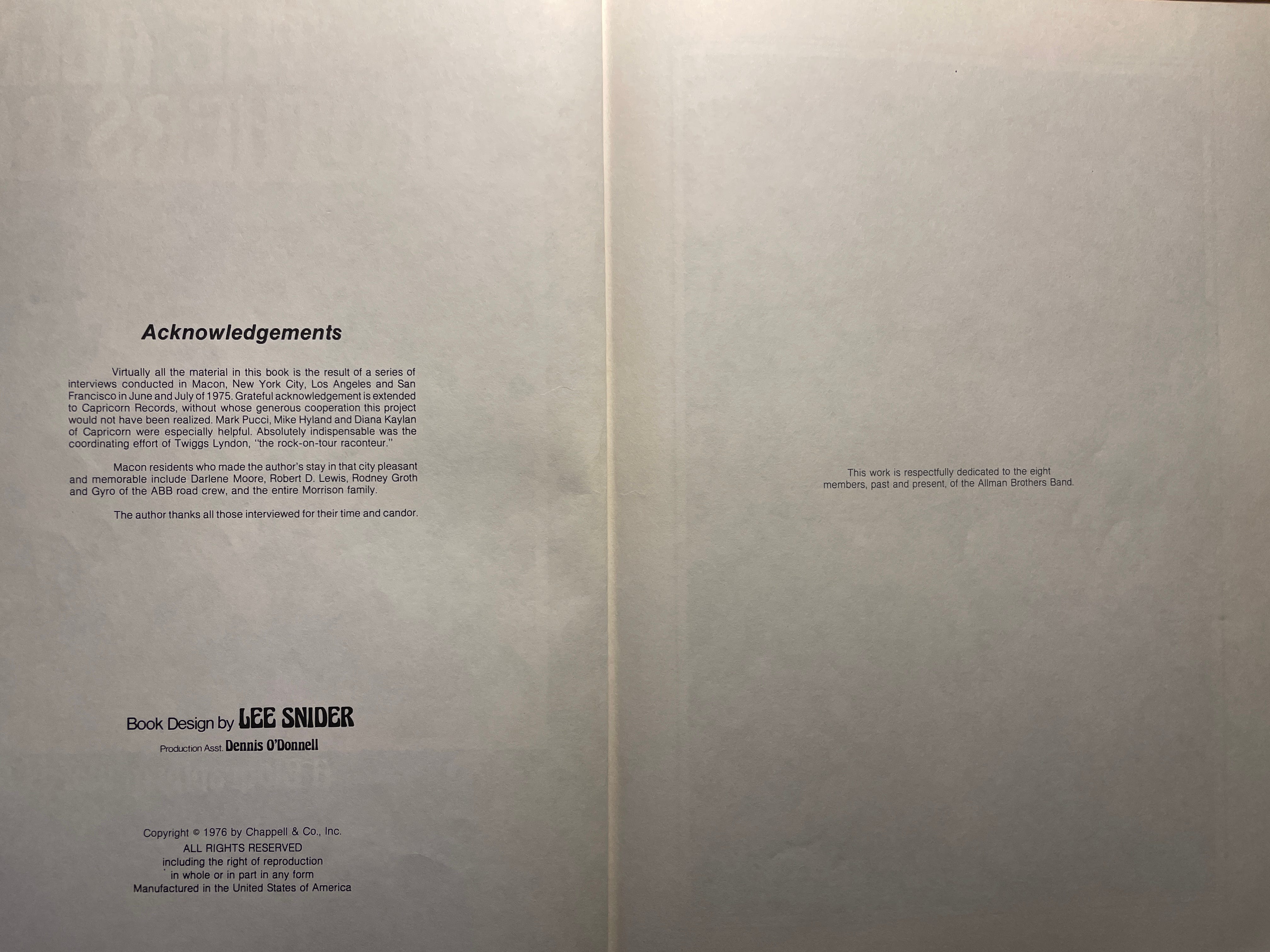
I love to read a book’s front matter.
Always.
I learn a lot about writers and their respective journeys, and appreciate and learn from the ways folks pay honor to others. Nolan’s Acknowledgments are simple: three paragraphs, each increasingly shorter.
Virtually all the material in this book is the result of a series of interviews conducted in Macon, New York City, Los Angeles, and San Francisco in June and July of 1975.
Grateful acknowledgment is extended to Capricorn Records, without whose generous cooperation this project would not have been realized. Mark Pucci, Mike Hyland, and Diana Kaylan of Capricorn were especially helpful. Absolutely indispensable was the coordinating effort of Twiggs Lyndon, "the rock-on-tour raconteur.”
The timing here is interesting, particularly given what a fraught time it was for the band. It was a fractured group that recorded Win, Lose, or Draw in 1975. Gregg had relocated to L.A. with Cher and was mostly absent from the sessions. Within a year, the group would break up. You wouldn’t know anything wrong by reading this book.
Capricorn’s promotions folks had a big hand in the book and I have a feeling that’s why it’s as thorough as it is.
And gotta love the mention of Twiggs, the band’s original road manager and one of Duane’s earliest disciples. This book is LOADED with great Twiggs stories.
Macon residents who made the author’s stay in that city pleasant and memorable include Darlene Moore, Robert D. Lewis, Rodney Groth and Gyro of the ABB road crew, and the entire Morrison family.
The author thanks all those interviewed for their time and candor.
The band was remarkably candid and cooperative as was everyone involved in the book. It really is an incredible document of the time.
Dedication
This work is respectfully dedicated to the eight members, past and present, of the Allman Brothers Band.2
This is a really nice touch, acknowledging Duane and Berry—as well as Chuck and Lamar—along with Butch, Dickey, Jaimoe, and Gregg.
The text is very respectful to the Allman Brothers Band as a band—Duane’s founding ideal that outlived him despite the odds.
Baby pictures. Snapshots of a shorthaired high school band called the Escorts.
Creased photographs of the same fresh faces, a few years later, with the written legend: the Allman Joys. The pseudo-psychedelic cover of an album on Liberty Records by The Hourglass. Then, blurry black-and-white enlargements showing the very first gigs played by the Allman Brothers Band. Amidst scrapbooks and memorabilia forming an informal archive, Mrs. Geraldine Allman speaks of her sons.
“I remember when we got the first guitar. It was a $19.95 Sears acoustical. He had earned the money on a paper route. He was a little kid at that time, just a brat. Not a brat, but, you know - 11, 12. You know what kind of a sound comes out of a dumb $20 Sears guitar! But he was so happy.” They were in Castle Heights, which is about 30 miles outside of Nashville.
First, the band’s name was Hour Glass, not the Hourglass. It’s a minor detail I know, but something the Champ3 pointed out and I keep up in his memory.
Second, Duane and Gregg weren’t at Castle Heights when Gregg got his first guitar. They were visiting their grandmother in Nashville when a neighbor showed him his guitar. Gregg saved up money to buy one when he returned to Daytona Beach.
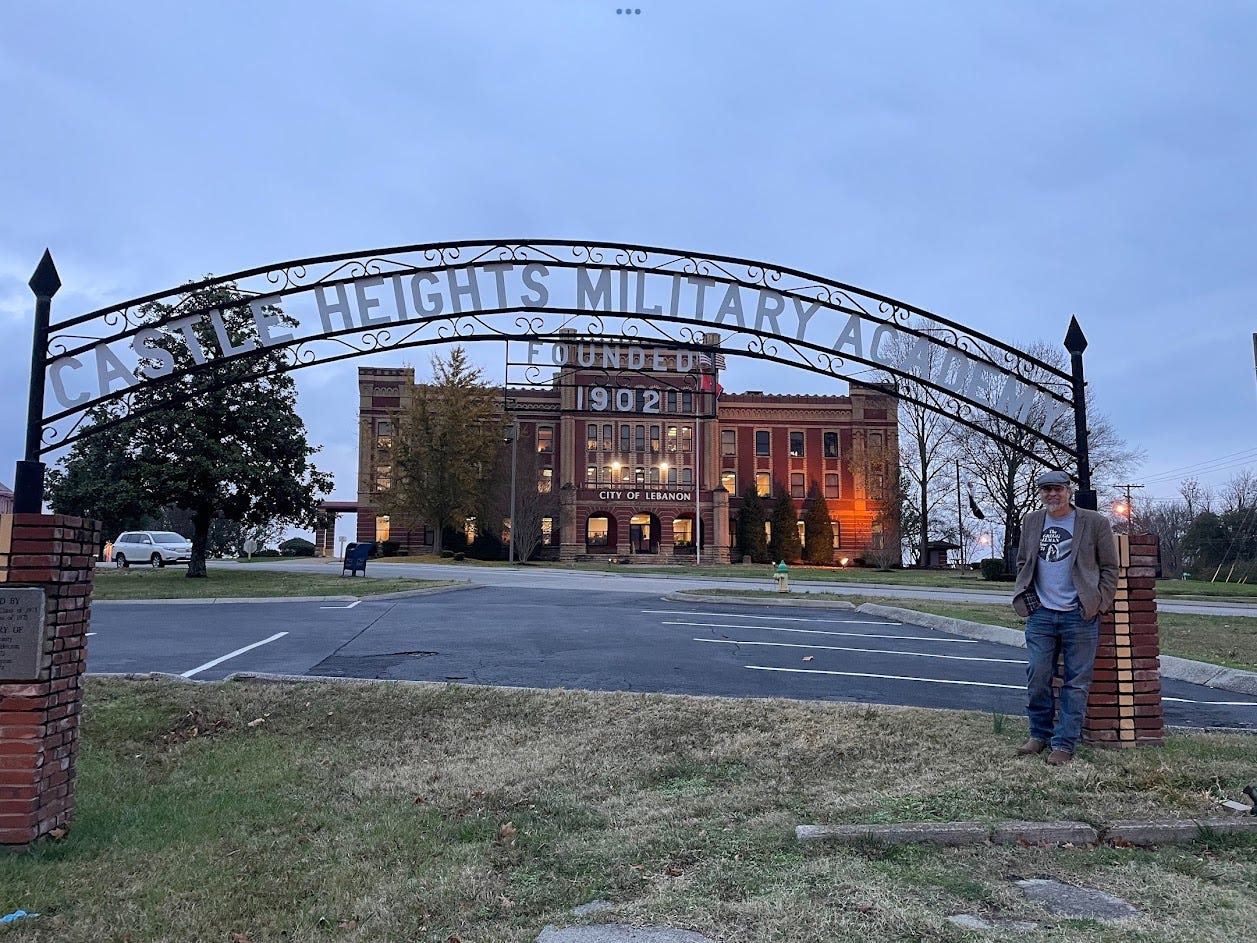
The Castle Heights Military Academy building is now the Lebanon (TN) City Hall. Also in Lebanon, Bradley’s Barn studio, where Duane and Gregg first recorded as the Allman Joys.
“Duane had one year of piano lessons; Gregg had a half a year, then his teacher got ill.”
Duane was scared of his teacher, telling her when he quit “The reason I don't wanna do this is because I'm never gonna need it for the rest of my life. I'll never need this damn music!' She died before I could get back and apologize to her. I always regretted that.”4
His teacher also told him he had beautiful hands. I can see why. His hands look made to play guitar.
Then they joined the marching band, and played trumpets, before we moved to Florida. Their father died then, and they thought we were going to fall off the earth; they felt insecure. So I said, look, I’d rather you stayed here in school, but if you want, when vacation comes, you can come home with me; we’ll pack up and move to Florida. That’s what we did. But then they weren’t happy there, and they went back to military school in Castle Heights.” She shows a picture of Gregg in school uniform, but has none of Duane - he tore his up.
Duane and Gregg had two separate stints at Castle Heights and hated both of them. The comments about their father, Willis Allman, are interesting to me. Never noticed that “felt insecure” line before, but it makes sense. Duane was three and Gregg two when Willis was murdered.
That’s when they started guitar again. They would play at parties, little sororities, things in school. It just grew out of that.
Duane - and I don’t say this just as a mother - Duane was a brilliant person. We sat on the couch one day. and by this time we had traded guitars so many times: he had his guitar, and he said to me, ‘Mother, I would go hungry to play this guitar.’ Well, then, I knew he was dedicated. I knew that he had picked his way.”
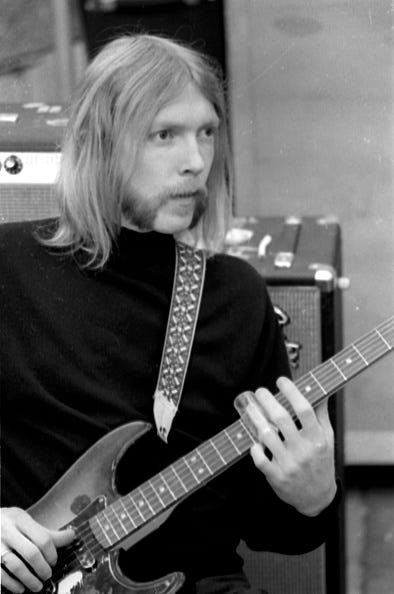
This is a powerful quote, but also one that’s easy to dismiss. Many mothers talk about their sons in these glowing terms. Add to it that Duane died young, before he was truly famous. His efforts were forever cast in bronze by 1971.
But here’s the thing: this quote is typical when folks talk about Duane. His was “a love affair with the guitar,” as his daughter Galadrielle called it.5
The Garbage Circuit
He wanted to snatch Gregg out of school. I said, no, you didn’t want to graduate, but Gregg wants his diploma. Duane didn’t need a diploma; later he regretted it, but he didn’t need it, he had everything born in him that he needed. But I said, Gregg’s gonna get his. So Duane waited around for Gregg to get out of school.
Then I said to them, if you’re going to be in this business, you gotta get into it. You go right down here to Local 601 and join up. Duane says, ‘Momma, how come we gotta spend all that money?’ I said, “Look, man, they ain’t but one way in this business. If you gonna go, you have to join the union, and you pay your dues. I said, These are the first dues. You got a lot more to pay in life.”
When they were ready, I sent them to Atlanta, to a friend of an acquaintance of mine, and they auditioned. And as Duane said, they worked the garbage circuit of the South. But they learned a lot of things.
Don’t miss that Geraldine insisted Gregg finish high school and that her sons join the musician’s union.
When the Allman Joys hit the road in 1965, that Atlanta booking agency was Allied Artist Agency.6
I love Geraldine cited Duane’s “garbage circuit of the South” reference. It’s from an interview with Ed Shane of WPLO out of Atlanta. (I’ve queued it up for you.)
Know what Duane Allman said? He said, ‘Mother, I never want a hit record. I do not want that wherever I go, I have to play the same song.7 I want to do whatever I want to do; I want to be free: ‘He says, ‘I don’t want fame and fortune. just want enough money to eat regular, and to pay my bills, that’s all I want out of life; and to play my guitar.” He did not want the fame and fortune. He never looked for it, and that’s why he attained it. When you don’t look for it, it comes to you.
When you try so damn hard, you never get it. This is the truth. Duane didn’t ever want nothing but to play his guitar, and make enough money to keep himself clean and fed, to pay his bills and his rent, and to buy himself one more guitar, if he wanted one more guitar. He didn’t ask too much out of life. And neither does Gregg.
The fame and the fortune has happened to Gregg, and it’s different, much different. We’ve been through so many changes, Gregg and Duane together, both of them. But they just played their music, and did what they wanted to do; and that’s where it’s at.
It’s 1975. Mama A. has seen her son Gregg and the Allman Brothers Band reach the ABBsolute peak of fame.
And Duane missed out on every bit of it.
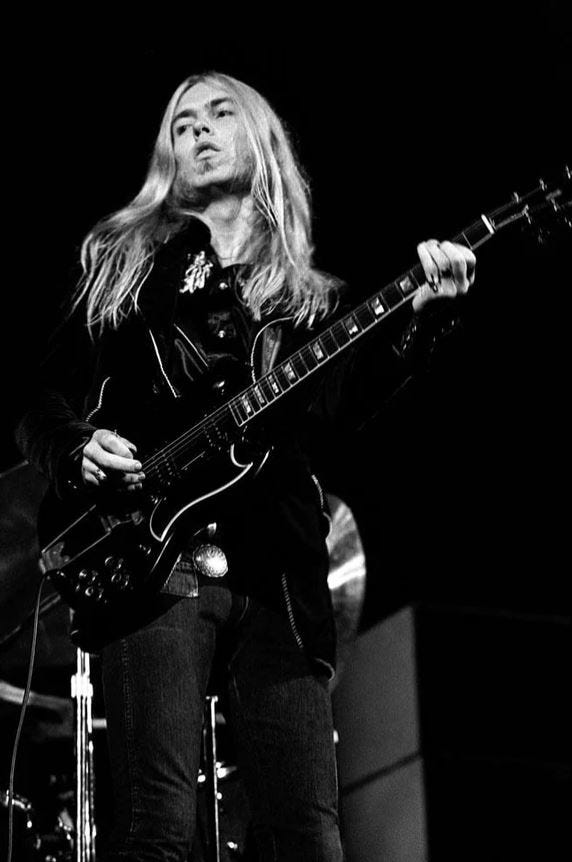
Johnny Sandlin, now a resident producer at the Capricorn Records Studios in Macon, Georgia, met Duane and Gregg Allman in Pensacola, Florida, in 1964.
The date was actually 1966.
Sandlin called the Allman Joys “amazing, the best band I had ever heard. They were playing very different music from what we were: English stuff, Yardbirds, and Beatles’ music. They were just incredible.”
Here’s a recording of the performance he’s talking about:
Duane was 17, Gregg was 16, and they had a band. “They were the first band I’d seen with long hair, and I mean long hair.” Sandlin says. “Hanging way down past their shoulders.
They were in danger; their lives were in danger, in the South.
“People just didn’t cater to that in a Navy town.”
The Allman brothers were the first long-haired musicians Sandlin ever encountered. “It was almost a cardinal sin to go around with long hair at that time, and I couldn’t believe they hadn’t gotten killed.”
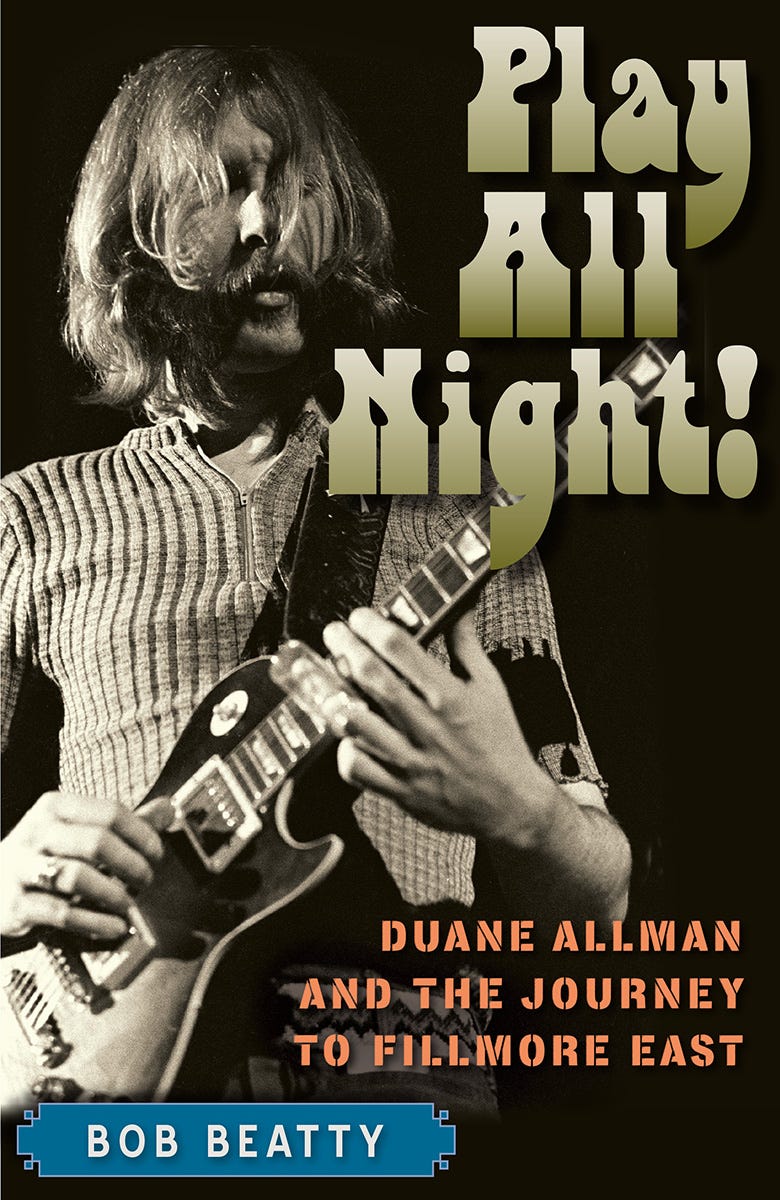
This continued to be an issue for the band into the early 1970s. It is also a major subtheme of Play All Night.8
Sandlin was the drummer in Five Minutes, a band playing on the same bill as the Allmans. When both bands broke up simultaneously, the remnants reformed into a single group.
We called it the Allman Joys, the Allman Act - anything we could use to get gigs at the time. We played a lot of rather questionable clubs, around St. Louis and all, until we met our manager, Bill McEuen, who was also the manager of the Nitty Gritty Dirt Band.
The Five Minutes also played as the 5-Men-Its. The group included the incredible Eddie Hinton, who quit the road to play sessions in Muscle Shoals.
“Then we set out to California to be rock ‘n’ roll stars.”
In Los Angeles, in 1967, the Allman Joys were rechristened the Hourglass, under which name they made two albums and several singles for Liberty Records.
The band’s style was Contemporary Adaptable; like the Fogerty brothers’ pre-Creedence group, the Golliwogs, Hourglass shifted musical stance from track to track. One moment they were a go-go band, the next a funkier Young Rascals, with a strain of r&b evident throughout.
While Hour Glass has its defenders9, no one in the band was pleased with the the music they recorded for Liberty.
As keyboardist Paul Hornsby remembered. “They didn’t know what a southern rock band was supposed to sound like. It was Black, blues-based rock ’n’ roll. [Producer Dallas Smith] kept referring to us as a Motown band. We do Black-oriented music, but it’s southern blues, southern black blues. It’s not Motown.”
Standout cuts from this band include “The Power of Love,” a likable tune sung with throbbing ‘60s emotion by Gregg Allman; and “Bell-Bottom Britches,” an obscure artifact of a period, worthy of inclusion in a time capsule (and bearing no resemblance to a similarly-titled song later recorded by Derek and the Dominos featuring Duane Allman).
“The Power of Love” was title track to the band’s second album. Liberty released the song as a single in 1968; it failed to chart.
“We got hooked up with a label that was not to our best advantage,” Sandlin continues, “and a producer who was not in tune with what we should have been doing. We never understood what they were trying to do with us, except make us another Gary Puckett and the Union Gap.
“We sat and rotted for a year and a half. Trying to keep up some kind of image. We couldn’t play in just any joints out there, just to keep our chops up; we had to play only the fashionable places. We played the Whisky a Go Go lots.”
No members of Hour Glass spoke fondly of the experience with Liberty Records. Their contract terms left them stymied creatively, forced to record songs and wear clothes selected by Liberty and producer Dallas Smith.
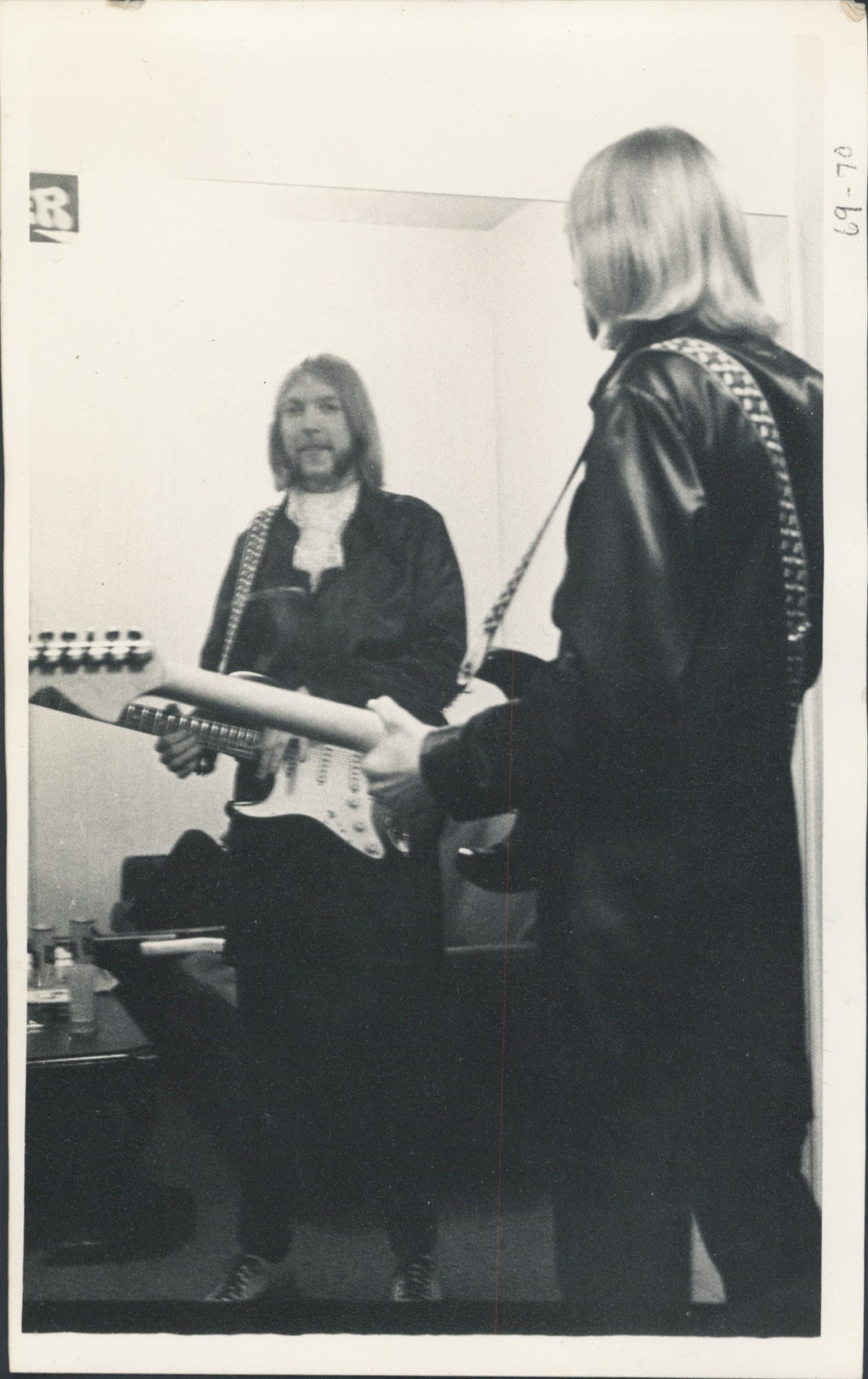
The music and image-making neither reflected nor appealed to the band. They simply wanted to play.
“The Fillmore. The Avalon. The Cheetah - the beautiful Cheetah, with the strobe lights; man, I couldn’t even see what I was doing when they turned those things on! We’d play once every week or two, and have nothing to do the rest of the time. A lot of what we played was copy stuff. Yardbirds material. Lotta rhythm and blues - Gregg has a great r&b voice.
By all accounts Hour Glass was a great live band. But Smith limited Hour Glass’s live engagements, leaving Duane and his mates in dire financial straits. The band found a measure of salvation when they finally reached the stage. Rather than songs from their album, they played the music they knew best, southern blues and R&B.
I collected some examples here: Playlist: Hour Glass repertoire.10
“I didn’t know what to think. I was scared to death. I didn’t like what I saw.
“This was ‘67, ‘68. Most of the groups happening then - the San Francisco Sound? - were basically inept musicians, copying old songs, playing rather meaningless fifteen-minute solos; but everybody said this was what’s happening. California seemed to drive the whole band crazy. Being from here, and going out there was just strange strange strange.”
The “here” Sandlin is talking about is the South. Los Angeles was disorienting. It left the southerners feeling “awfully alienated.”
Southern music offered comfort. Hour Glass bass player Pete Carr recalled playing the “The Long Black Veil.” “I remember us harmonizing on it, and it really was a moment separated from everything else we were doing. It was like a close family thing.”
Final note: I’m going to leave “inept musicians, copying old songs, playing rather meaningless fifteen-minute solos” unanswered for now. Remember that he’s talking in 1975, at a time when the jamming excesses of the late 60s were out of vogue.
One thing Duane found to occupy his time was learning slide guitar.
Sandlin was not one of his biggest encouragers. “I asked him what the hell he was doing with that bottle. ‘Man, that sounds terrible!’ He had some records he was learning licks from. I’d say, ‘Man, as good as you play, why do you do that damn thing on your hand?’ It didn’t sound good at all; it was just horrible. And we would do it onstage. And sometimes it’d work and sometimes it wouldn’t. But then all of a sudden, you look around and he’s doing things that nobody else ever done on it. I’m glad it wasn’t up to me.”
Anyone who’s ever struggled to play slide can relate to Sandlin. I always find it funny to think of Duane Allman struggling to play anything on guitar.
But to think he struggled to learn slide really blows my mind.11
Meanwhile, Hourglass morale deteriorated. “One day, the band would have broken up. The next day, we were back together. We wanted to play, but we weren’t sure exactly what; we had no real strong direction. Then somebody said, we gotta get home, and we left there and didn’t look back.”
In the famous FAME Studios of Muscle Shoals, Alabama, Hourglass recorded some songs that were closer to the music they thought they should be playing; their record company thought otherwise.
This session, in April 1968, resulted in a four-song demo tape that Liberty Records rejected with prejudice. The session was Duane’s first interaction with FAME Studios. By the end of 1968, he was a FAME regular.
“We tried to go back to playing clubs in the South. We had made good money before - two, three, four hundred a week - before we even went to California; but you can’t go back. Finally Duane and Gregg went to Daytona. I [Johnny] went home to Miami; I played sessions and went hunting for a year.”
This was September 1968, a momentous three-week stretch in Duane’s life that began with him in L.A. and ended in Muscle Shoals.
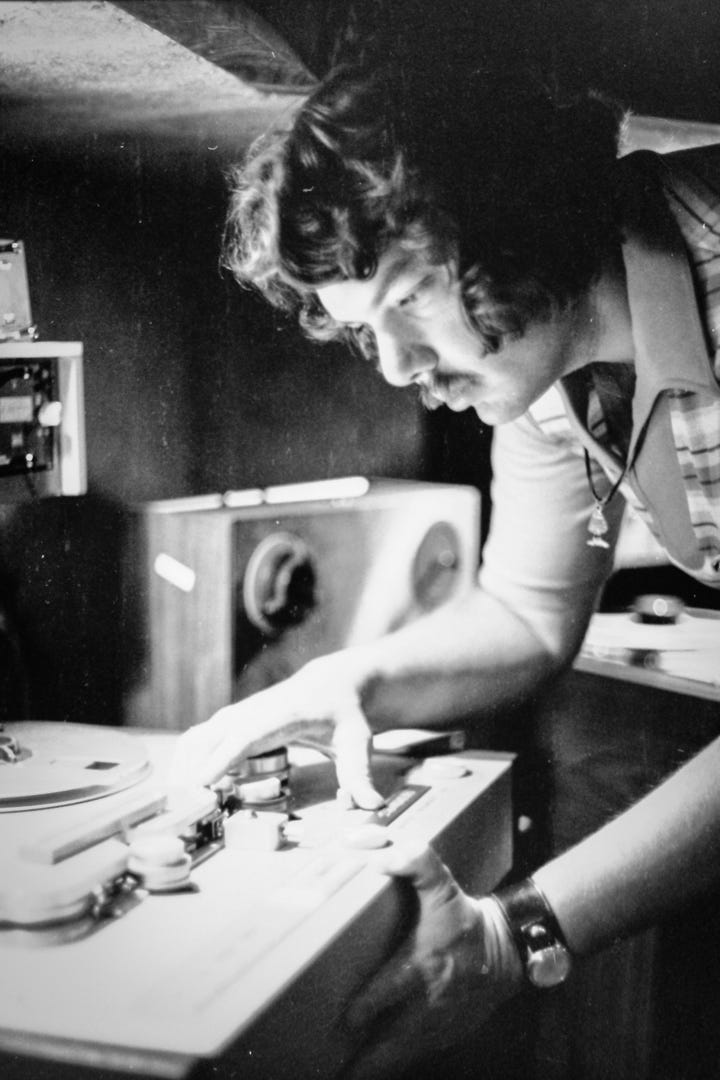
Sandlin’s home was Alabama, not Miami, so I’m not sure where that came from. He eventually ended up in Macon working as a house producer for Capricorn Records.
He produced Brothers and Sisters and Win, Lose, or Draw for the Allman Brothers Band; Laid Back and The Gregg Allman Tour for Gregg; and Highway Call for Dickey Betts.
Thanks to each of you for being a paid subscriber to Long Live the ABB. This post was just for you. I hope you found the context interesting.
Let me know your thoughts. And please tell others.

I originally published this to paid subscribers May 2024.
Eat a Peach was dedicated to Duane; Brothers and Sisters to Berry. They continued this tradition when they dedicated the Dreams box set to Duane, Berry, Twiggs, and Lamar.
Bill “The Champ” Proudfoot was a Golden Gloves boxing champion who edited my Ph.D. dissertation. He was a huge Allman Brothers Band fan who died a few months before I published Play All Night.
From Bud Scoppa’s The Rock People: Interviews with 13 Top Stars and Groups (1973).
Galadrielle’s Please Be with Me: A Song for My Father, Duane Allman (2014) is my ABBsolute favorite book about Duane, including my own.
See this 1965 Allman Joys headshot.

Somewhat ironically, Duane spent most of 1971 playing the same 7-10 songs live. There was a reason for that: www.longlivetheabb.com/p/about-those-1971-setlists.
You know who you are.
Here’s the in case you missed it above: www.longlivetheabb.com/p/playlist-chapter-4-hour-glass-repertoire. You’re welcome.
And gives me some hope as well. I first tried slide in the 80s after watching the Ralph Macchio movie Crossroads. Took me nearly 30 years to feel any measure of comfort playing it.
Brought to you by the paid members of the Long Live the ABB community.
MUSHROOM MAGICIANS: Steve Marshall, Brent W. Hammond, Ken Lupson, Laura McCarty
PAID MEMBERS: Allen Barnes, Baileys Mike, sswoger, Bob Johnson, Bruce Miles, Buddy Lewis, Caroline Doolittle, Chuck Zumwalt, Clifford Morse, Craig Stephens, Dennis Newton, Denny, Ed Ashton, Ed Pokorny, F. D., Frank Young, Gary Wonwayout, Gary Williamson, George Holman, James Reynolds, James Yerrill, JD Guitar, Jeff Kushmerek, Jeff Schein, Jerry K, JoaquinDinero, Joe, Joe Sokohl, Joel Berger, Joel Tanzer, John Dolan, John Haughey, Jordan David, Joseph Lilly, Kenton Lee, Kevin Walker, Kurt Nielsen, Long Live the ABB, Mark Leitner, Martha Haynes, Peter Poulos, Phillip Page, Preston Root, Randy Woodall, Ray Tillman, Robert Porter, Rose Brandt, Surrender Cobra, Taylor Kropp, Tim Langan (Hot ‘Lanta Tim), Tina Christopher, Tom Pragliola, Tony Gioia, Wade McCurdy, Bob and Laura, Gary Smith, Wiszowa, Cwktwo, Hlnbkt, Cabinetsales, Art Dobie, Stanleyglennie8, Danbookin
LLtABB SWAG
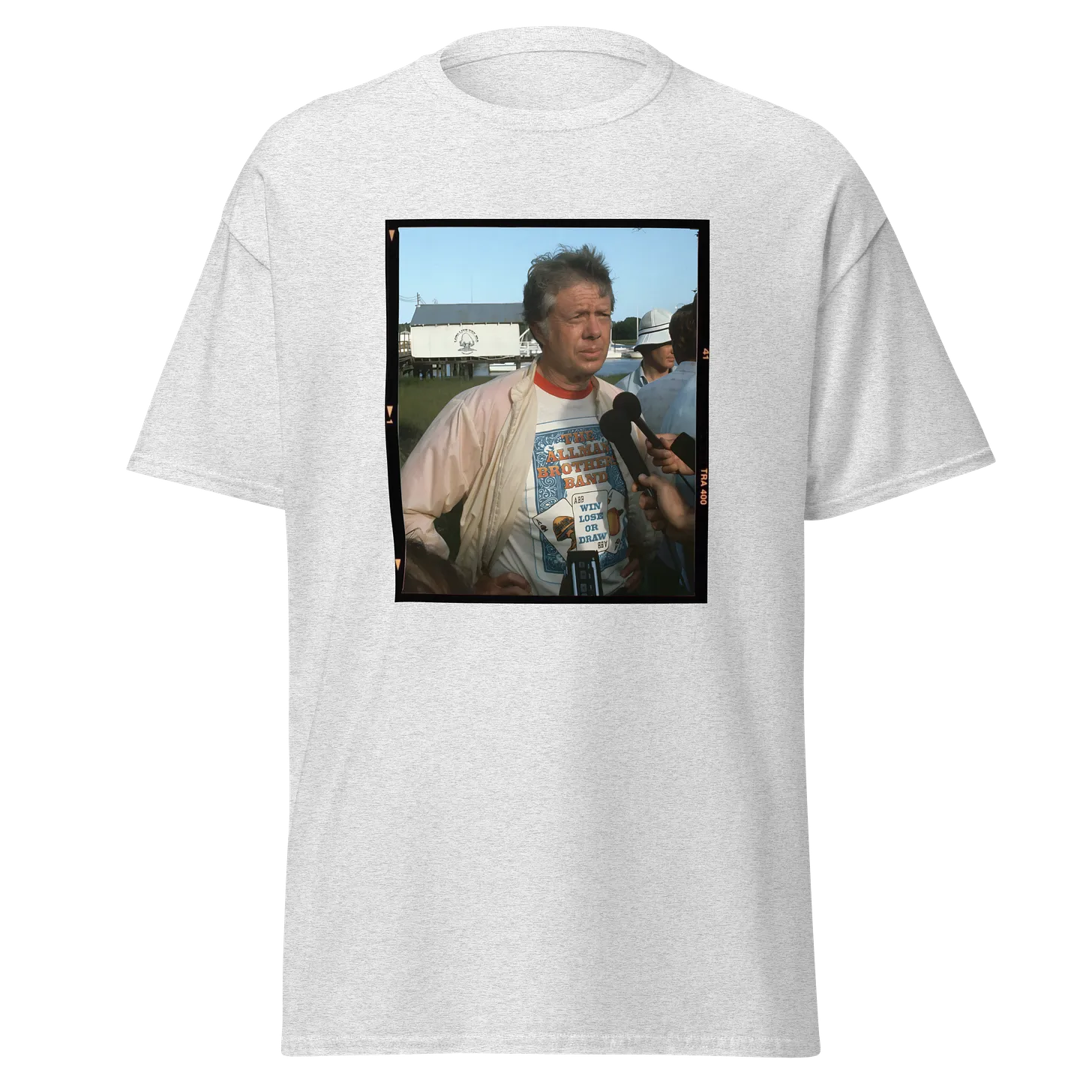
Jimmy Carter. Walt McNamee shot of Jimmy Carter in an Allman Brothers shirt July 4 weekend 1976, shortly after the band’s break-up and Gregg’s testimony in a federal drug case. I tagged the barn in the back with Long Live the ABB shroom 2 from Psychodelik Pete.
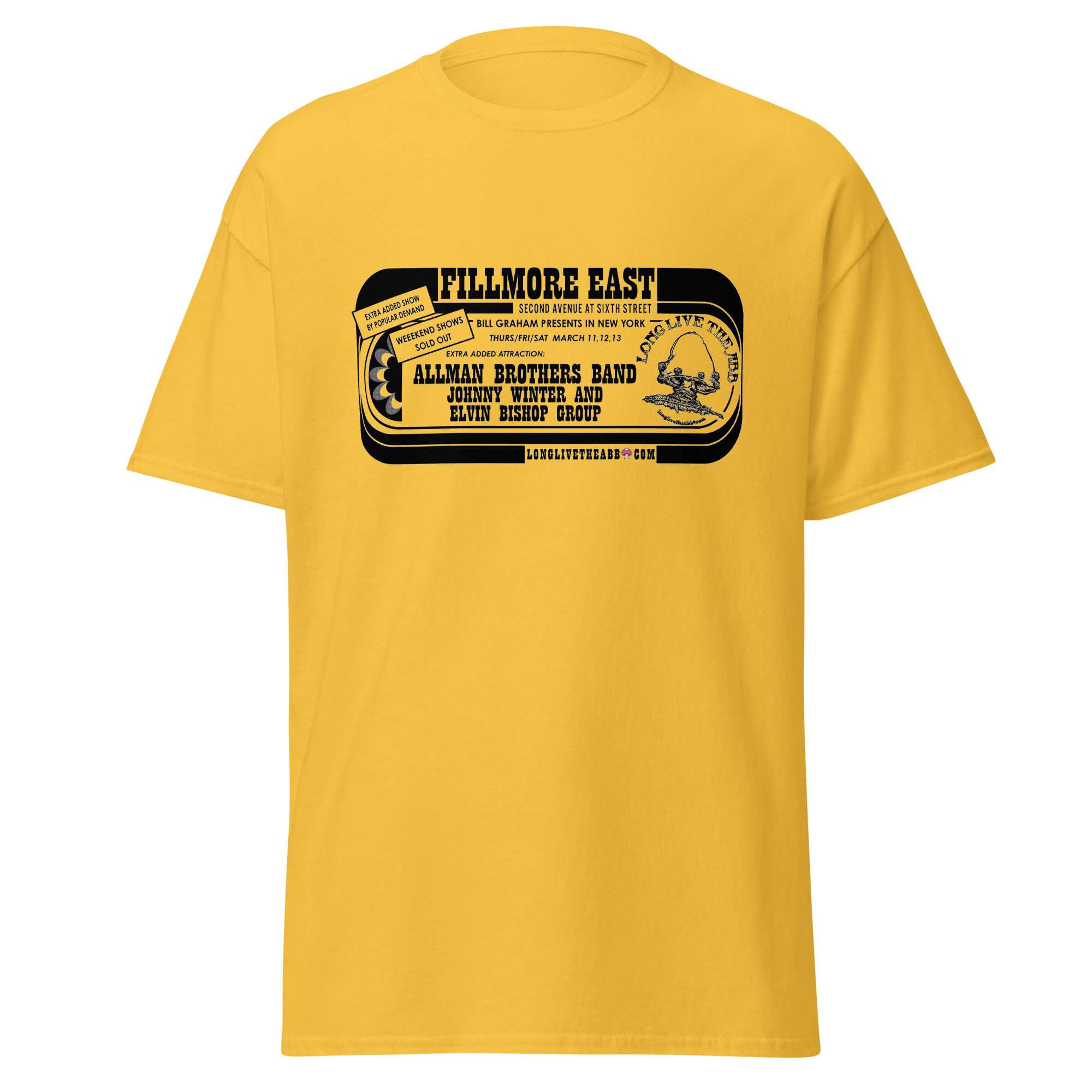
Fillmore East ad. Adaptation of original ad for the Fillmore East recording sessions. I replaced Johnny Winter’s face with the LLtABB shroom and moved the Allman Brothers to the TOP of the bill, a spot they EARNED after Johnny Winter demanded they switch places.