


Bob Dylan and I go way, way back. Dylan’s were among the first songs I learned on guitar (“Mr. Tambourine Man,” to be specific). My folks also had a scratchy copy of Dylan’s Greatest Hits, which led off with the immortal romp “Rainy Day Women #12 & 35” and included, among other bangers, “Like a Rolling Stone”—songs that have been in my listening/playing repertoire since age 12 or so.
As a historian of the 20th century American South, Dylan’s is an era I’ve spent a lot of time studying over the years. My familiarity extends to the folk movement and the stories of John Hammond, Alan Lomax, Pete Seeger and the Weavers, Joan Baez, events like the Newport Folk Festival, and the Greenwich Village folk scene that birthed the rock scene the Allman Brothers Band were such a key part of.1
Dylan’s electric set at Newport in 1965 was a groundbreaking rock & roll event, a disruption that reverberates today. From the beginning, Dylan pushed back against categorization and genre. It’s a theme throughout his life and career, as it has been for the Allman Brothers Band.2
On Bob Dylan’s 85th birthday (May 24, 2026), here are some thoughts on Dylan & the ABB.3 I put the musical connections into a playlist. Tidal’s options are more limited than Youtube, particularly when it comes to Allman Brothers’ covers of Dylan songs.
PLAYLISTS
🍑 YOUTUBE PLAYLIST (24 songs)
🍑 TIDAL PLAYLIST (15 songs)
LINER NOTES
Liner notes are typically reserved for paying subscribers. Their support is making these available to you today.
“Trouble No More” / “Someday Baby”
I believe this is the only track Dylan and the Allman Brothers Band each released.
Dylan called it “Someday Baby” on his 2006 Modern Times album.
The Allman Brothers recorded it as “Trouble No More” on their debut album in 1969 and again on 1972’s Eat a Peach. Their version comes from Muddy Waters.
Both songs are based on Sleepy John Estes’s “Someday Baby.”
Duane’s connections to Dylan are obscure.
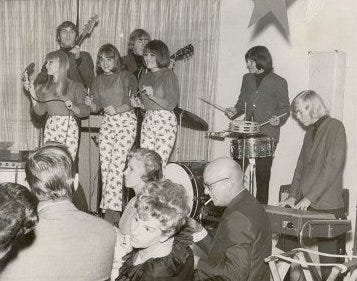
The Sandpipers
In 1965, the Allman Joys joined forces with the Sandpipers, a girl group from Pensacola. Duane finagled an audition in New York City with Dylan’s producer Bob Johnston, then working on Blonde on Blonde. Remembered Sandpiper Charlyne Kilpatrick, “Johnston wasn't interested in the Allman Joys, which wasn't very smart. He was very interested in us, but he was extremely busy in the studio. He was so exhausted. He asked my parents to bring us back in two weeks.” The two bands went their separate ways shortly thereafter.4
Johnny Jenkins “Down Along the Cove”
This is a cut from Duane’s solo project at FAME, the one he abandoned to form the Allman Brothers Band. Jenkins overdubbed vocals on this Bob Dylan original from John Wesley Harding. Players include Duane and Berry Oakley, and Duane’s Hour Glass bandmates Paul Hornsby, Johnny Sandlin, and Pete Carr.
Otis Rush "Reap What You Sow”
The link isn’t the song, it’s not Dylan’s, but producer Mike Bloomfield, who was Dylan’s guitarist on both Highway 61 Revisited and at Newport. From Rush’s Mourning in the Morning, recorded at FAME in February 1969, shortly before Duane and Jaimoe left for Jacksonville.
Ronnie Hawkins “One More Night”
From Nashville Skyline. Hawkins had Dylan connections through the Band, who were the Hawks, his backing group before they went off on their own. Recorded in September 1969 at Muscle Shoals Sound.
John Hammond, Jr. “Shake for Me”
Duane’s second brush with a Bob Dylan producer, Hammond was the son of the Columbia Records producer of the same name.5 He had a couple of memorable exchanges with Duane, the first in Muscle Shoals in November 1969.6
“When I arrived, they thought I was going to be Black and I thought they were going to be Black! They got pretty cold to me, and I didn’t know what to make of this. It was Roger Hawkins, Barry Beckett, Jimmy Johnson, David Hood, Eddie Hinton—and for three days I tried to get them into what I was playing, and they just seemed to play a little bit awkwardly.
Then on the scene arrives this guy with long red hair down his back, eyebrows that crossed, and a mustache that went all the way into his sideburns, wearing a T-shirt that said City Slickers on it. He pulled up in this milk truck, and everybody said, ‘Hey, Duane, how you doin’ man?’ Everybody just fell all over themselves for Duane, you know. He was their idol.
He said, ‘Where’s this John Hammond guy? I want to meet this guy—I really dig him.’ They said, ‘You do?’ And they all looked at me with new respect.
I was introduced to Duane, and he said, ‘I sure dig your stuff, boy, and I sure would love to play on your record, if it’s okay.’ I said, ‘Sure, I guess so.’ I had never heard him play before, but these guys worshipped him. As soon as Duane gave me the okay, the session went fantastic.”
The first track they cut was Howlin’ Wolf’s “Shake for Me.”7 The song kicks off Hammond’s Southern Fried.
“We decided to do ‘Shake for Me’ and my jaw just slacked. This guy was just phenomenal. So, all of a sudden all of these guys that I could not communicate with before understood exactly what I meant and that was the beginning of a short lived, but intense relationship. Duane was just phenomenal and a really cool guy; and everything just came together and we made the whole record in one week.
I was floored. He played on and on and on! He was just incredible.”
Open E tuning
During this same session, Hammond showed Duane how to play slide in open E tuning. He continued to play in standard tuning on “Dreams” and “Mountain Jam,” but between the first album and the March 1971 Fillmore East sessions, Duane adapted “Trouble No More” to open E and from that moment forward, played slide pretty much exclusively in that tuning.8
I’ve put both ABB versions of “TNM” on the playlist along with “Someday Baby” by Dylan and Estes and Muddy Waters on “Trouble No More.”
The Allman Brothers Band covers Dylan
As far as I can tell, the ABB never covered Dylan between 1969 and the early 2000s. This changed when Warren Haynes rejoined the band and the setlists opened up considerably. Here’s what I could track down of the Allman Brothers covering Dylan—all but a couple are on the Youtube playlist.
“Don’t Think Twice, It’s Alright” most often (exclusively?) played when Susan Tedeschi sat in. First showed up in setlists in 2003, played 28 times.
“Blind Willie McTell” joined the repertoire in 2010 and appeared 27 times.9
“Highway 61 Revisited” 2006 (15)
“It Takes a Lot to Laugh, It Takes a Train to Cry” 2008 (15)
“All Along the Watchtower” 2007 (11)
“I Shall Be Released” 2007 (4)
“Down Along the Cove” 2011 (3)
“Knocking on Heaven’s Door” 2011 (2, both with Steve Earle)
Woody Guthrie “Going Down the Road Feeling Bad”
I don’t know if Dylan ever covered this Woody Guthrie tune, but it was a centerpiece of the Allman Brothers Band’s acoustic sets in the 1990s, including the first time I saw the band.
Guthrie was an important part of the Dylan biopic A Complete Unknown, which is why I included this here. Plus, it’s always such a pleasure to see Dickey enjoying himself playing acoustic onstage.
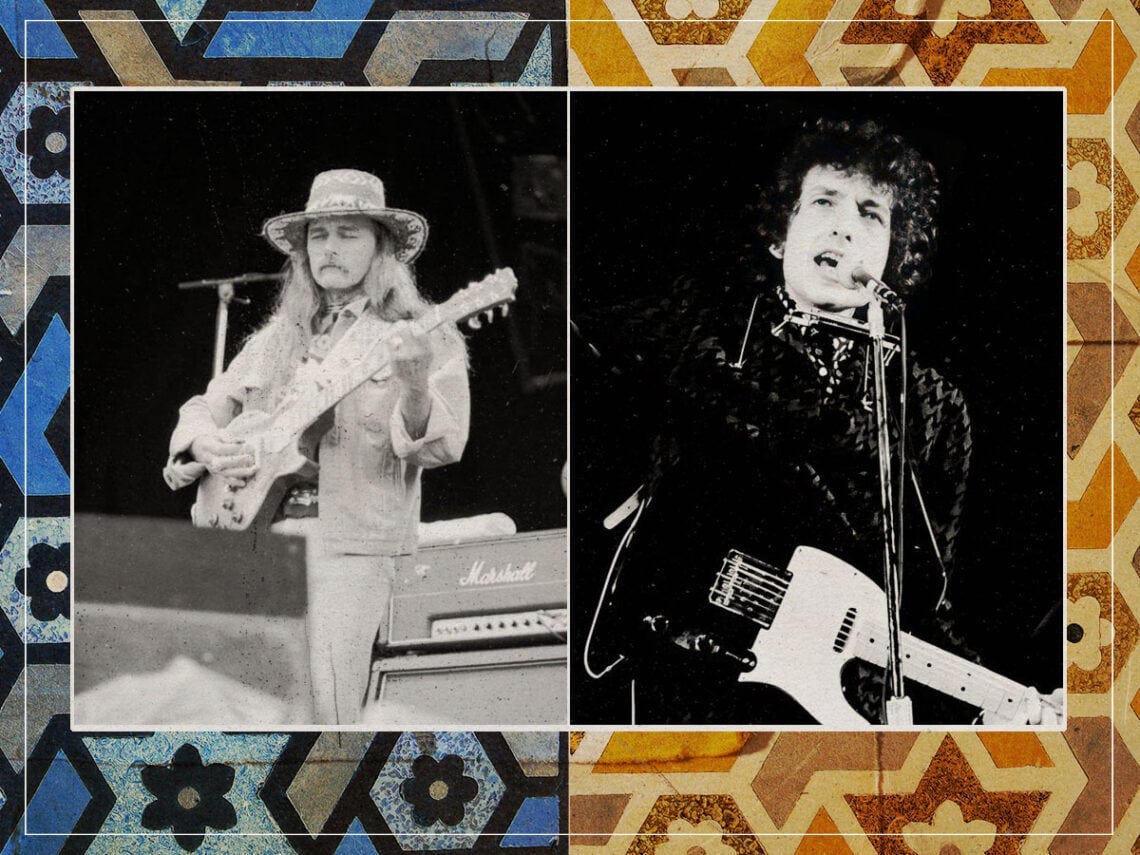
Dickey and Dylan
Dickey and Dylan had not only a mutual admiration society, but also a personal relationship. Each name-dropped the other in song: Dickey in “Tombstone Eyes” and Dylan in “Murder Most Foul.”10
“Tombstone Eyes”
It’s clear this song meant a lot to Dickey. He worked hard on it for five solid years. Debuted at the Beacon Theatre in 1996, it underwent several iterations and name changes before Dickey settled on “Tombstone Eyes” for his 2001 album Let’s Get Together.11
The first two verses conjure visits to Elizabeth Reed’s gravesite in Rose Hill Cemetery for hush-hush trysts with Carmella (Storniola) Scaggs in the band’s early days in Macon.12
“Not so long ago, just a few years back.
We used to hang out down by the railroad tracks.
The guitars playing and the singers made rhyme.
It was a good time for being free.Bouquet of flowers on her kitchen windowsill.
We listened to Bob Dylan’s stuff he’d just done in Nashville.
Lay down on the hillside and look up at the sky
We had it all you and I.”
The Dylan reference is Nashville Skyline, released April 9, 1969, around the time Dickey and the band relocated to Macon.
“Tangled Up in Blue”
Dickey covered this Blood on the Tracks tune on his mostly acoustic 2002 album Collectors #1.13 It is my favorite track on an album that I dearly love. Betts is playing on an Alvarez gut string here, which is why you don’t hear him bending a lot of notes. This is a deep cut and a way cool arrangement. Don’t skip this. (You’re welcome.)
“Ramblin’ Man”
Then there’s this gem, Dickey and Dylan dueting on “Ramblin’ Man” in 1995. The sound isn’t great, but it’s worth a listen.
The backstory is even better, I’ll quote a bit from Flagging Down the Double E's/Ray Padgett:
Bob wanted to do “Ramblin’ Man.” I said, “You don’t know the words to that, do you?” He said, “I know all the words to ‘Ramblin’ Man.’ I shoulda wrote that song myself.”
I said, “Okay, let’s check. If you don’t know, just make shit up, and you’ll do well.”
So we sang “Ramblin’ Man.” He sang every word exactly the way I wrote it.14
Gregg and Dylan
First, a note from Jaimoe.
“Gregory’s music and singing were based on rhythm and blues and blues but his songwriting was so influenced by people like Bob Dylan and Jackson Browne and other people who wrote poem songs. What made him so unique is the way he combined those things.”
“Just Like a Woman”
Gregg sat in on this Blonde on Blonde track with Gov’t Mule a few times over the years. It saw official release in 2015’s Dub Side of the Mule.
“Going Going Gone”
This one, from Gregg’s Southern Blood, hits HARD. It’s also the only Dylan song Gregg ever recorded,15 which is a surprise to me. Gregg was one of his generation’s greatest interpreters, and Dylan’s vast catalog seems a bit of a missed opportunity for him.
Or perhaps it’s like Jaimoe said, Gregg captured the Dylan spirit with his own writing.
Butch and Dylan
Butch Trucks and the Freight Train Band “Highway 61 Revisited”
Butch’s only vocal was his turn on a cut made most famous by Johnny Winter, I suppose. This is a raucous version with one of two(!) bands Butch toured with after the Allman Brothers Band closed up shop in October 2014.
Frogwings “Leopard Skin Pillbox Hat”
Apparently the Allman Brothers Band considered cutting a version of this Blonde on Blonde track for 1994’s Where It All Begins but shelved the idea for “No One to Run With.”
In 1997, Butch revived it for his band Frogwings. Here’s the final performance of the Edwin McCain-fronted Frogwings (which I much prefer) 5/3/98 Sunfest West Palm Beach.16
Thanks for being here y’all.
Until next time…
And later punk rock.
The same is true for the Allman Brothers Band and Southern rock.
I warned you the connections were obscure.

Not a Dylan cut, just a longtime favorite. (Remember, the connection is Hammond’s dad to Dylan as a producer, though Dylan revered Wolf.)
Done Somebody Wrong; Don’t Keep Me Wonderin’; Statesboro Blues (adapted to open E); One Way Out; Stand Back.
An even deeper connection is McTell wrote “Statesboro Blues.”
Song was also called “Those Eyes Again” “Her Eyes Again” and “Good Times (Don’t Fade Away).”
She was Boz Scaggs’s girlfriend or fiancé or wife, I’m not sure of the timeline.
I regularly tout The Collectors #1 around here. Unfortunately, Dickey never released a Collectors #2 set.

Lots more on that here longlivetheabb.com/p/gregg
Great article, Bob! I love the way you have gathered these facts and tunes in one well-written article, which I will save.
FYI, Bob Dylan did cover Going Down the Road Feeling Bad with the Band in the summer of 1967, and it can be heard on Disc 6, track 11 of The Basement Tapes Complete.
And special thanks for that link to Dickey and band playing Tangled Up In Blue!